Note · Materials
Salt air, and what it does to timber, glass and steel
A sauna in the Algarve and one in Galway fail for the same reason: salt. It travels on the wind, settles on every exposed surface and does its work slowly. Knowing where it goes and what it attacks tells you what to specify and what to look at once a year.
Sections on this page
- Where salt actually goes
- Steel: why 316, not 304
- Timber: thermally modified ash and cedar
- Glass and seals
- Chillers and the condenser coil
- Rinsing without harm
- What salt does to each material, side by side
- The first hundred metres and the next thousand
- Inside the cabin, where the salt follows you
- A calendar for the owner
- What this means at the quote stage
The short version: use 316 stainless steel for anything that touches water or salt air, thermally modified timber or cedar for the cabin, ventilate the cladding so it can dry, rinse the glass and the chiller coil with fresh water now and then, and look at the seals and hinges once a year. The rest of this note is why.
Where salt actually goes
Sea salt does not stay at the beach. Surf and wind throw fine droplets into the air, and they settle on surfaces within a few hundred metres on a calm day and a good deal further in a storm. On the Atlantic coasts of Ireland, Portugal, Madeira and the Canaries, the exposed side of a building collects it all year. The Mediterranean is gentler, but a terrace above the water in Mallorca or Cyprus is still in the aerosol zone. A cabin or a pool plant within sight of the water should be designed as if it were marine.
Steel: why 316, not 304
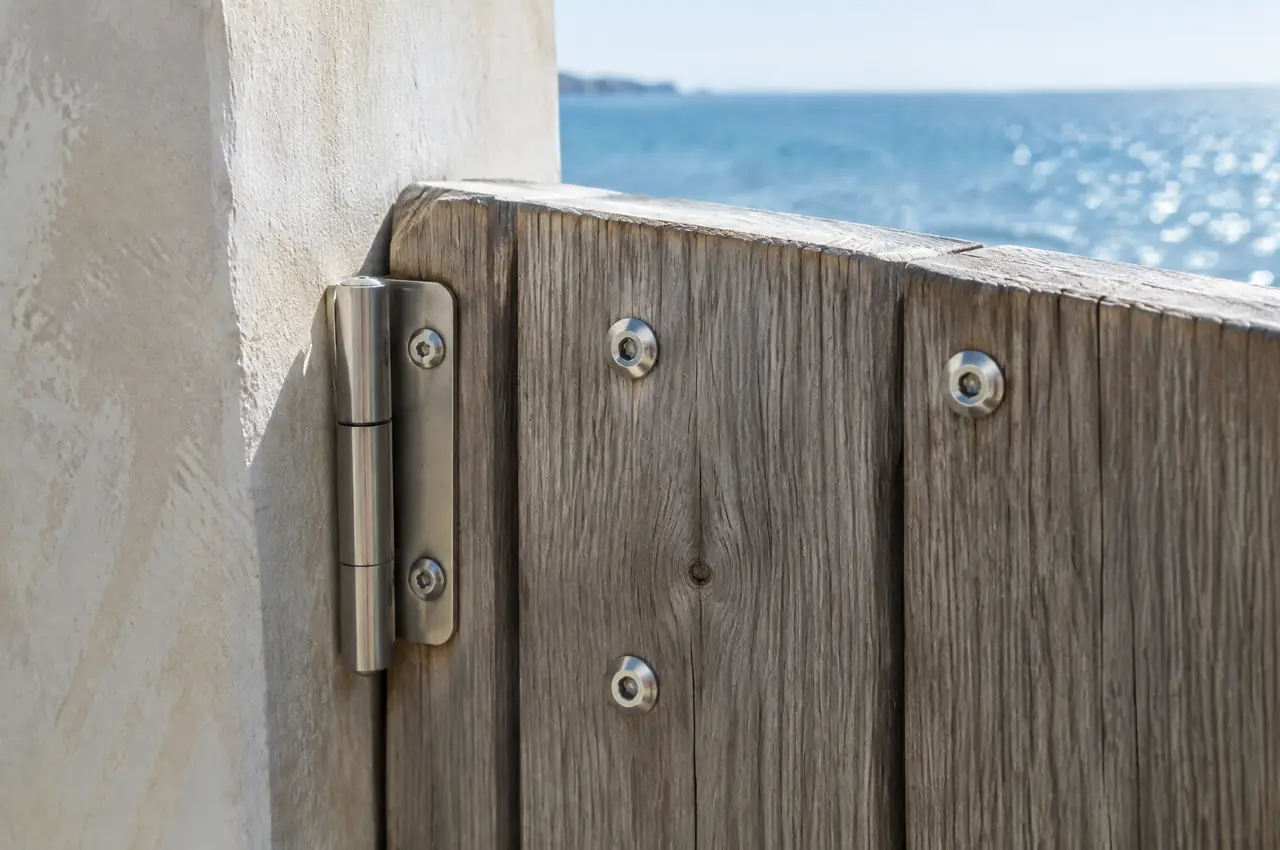
Both are stainless, and in a kitchen they behave the same. Near the sea the difference is molybdenum: grade 316 contains it, grade 304 does not, and it is what helps 316 resist the chlorides in sea air. A 304 handrail near the surf will show brown tea-coloured staining within a season or two; the same rail in 316 usually stays bright. Hinges, door handles, screws, handrails, anchors, drain grates and the display post by the pool should all be 316, and so should the fixings you cannot see.
Timber: thermally modified ash and cedar
Thermally modified ash and cedar are stable, resist rot and weather to a soft silver. They need three things from the design. A ventilated cladding, with an air gap behind the boards so water that gets in can leave. A base that never sits in a puddle. And sealed end grain, because water enters timber through the cut ends first. If you want to keep the honey colour, an oil with UV protection once a year does it; if you like the silver, do nothing.
Glass and seals
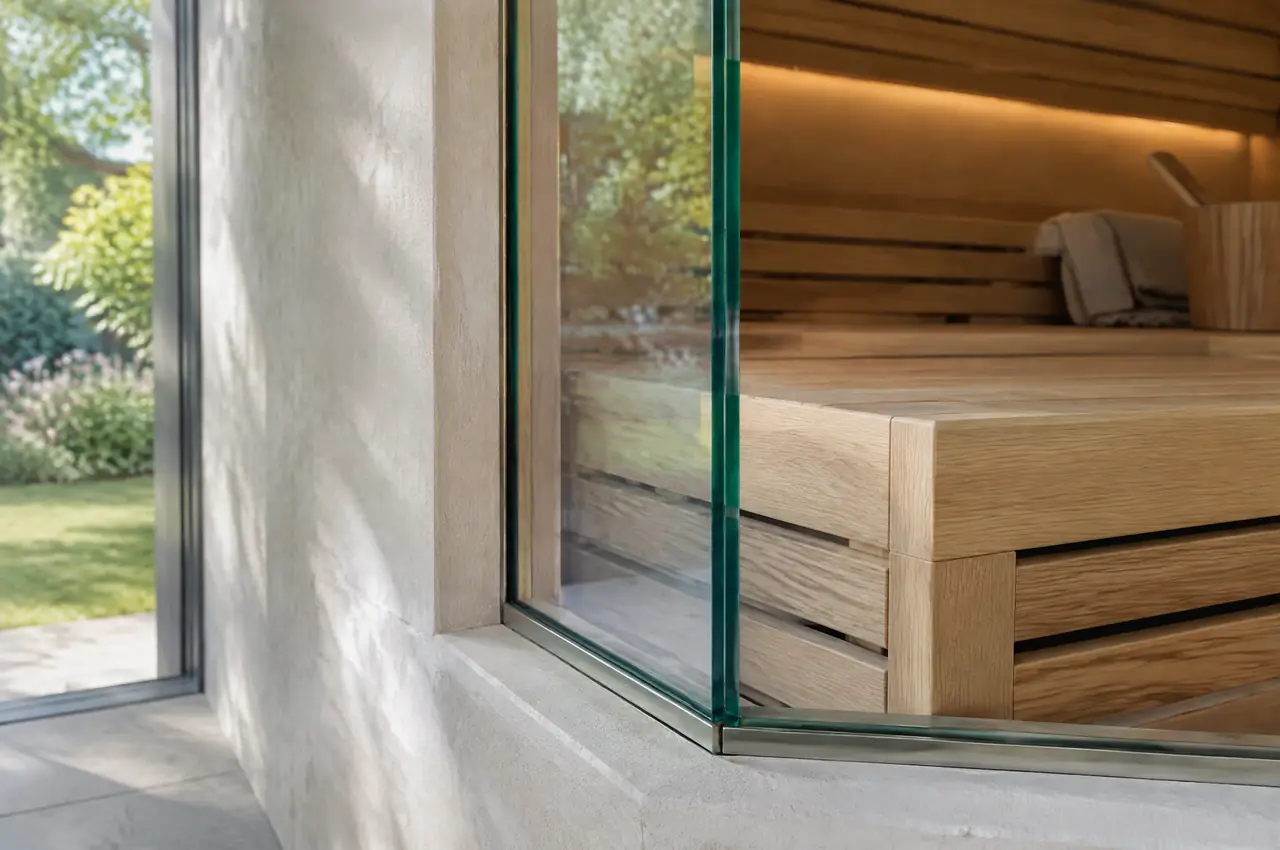
Salt dries on glass as a film. Rinse it with fresh water and wipe with a soft cloth; do not scrub it dry. The seals matter more than the glass. Silicone and EPDM seals survive heat and salt but harden with age, so a door that has begun to close with a click rather than a sigh is telling you something. Check hinges and the threshold at the same time.
Chillers and the condenser coil
A chiller moves air through a finned coil, and the fins are usually aluminium. Salt deposits on aluminium fins and corrodes them, which reduces airflow and cooling. Position the machine out of direct spray and out of the wind, ask whether the coil has a protective coating, and rinse it with fresh water once or twice a year. See chillers and plant.
Rinsing without harm
Use fresh water from a hose on a gentle setting, working from the top down, and let it run away through the drains instead of pooling on the deck. Keep the pressure washer in the shed: a hard jet drives water and salt behind seals and into the end grain, which is the opposite of the job. Look at the places that stay out of sight, such as the underside of the deck edge, the lower hinge and the foot of the door frame. Afterwards wipe the stainless parts that people touch with a soft cloth; the cloth lifts the film that rain would only spread.
What salt does to each material, side by side
| Material | What salt does | What we specify |
|---|---|---|
| 304 stainless | tea-coloured staining, then pitting | avoided near the sea |
| 316 stainless | stays bright with an occasional rinse | every fixing, hinge, handrail and display post |
| Aluminium fins | white corrosion, lost airflow | protected coil, shaded position, a rinse routine |
| Thermally modified ash | silvers; end grain absorbs | sealed ends, ventilated cladding |
| Toughened glass | a salt film that dulls it | rinse with fresh water, never scrub dry |
| Silicone and EPDM seals | harden over years | check each quarter, replace when brittle |
| Outdoor electrics | salt in connectors and boxes | enclosures with an ingress rating suited to outdoor use, sealed glands |
The first hundred metres and the next thousand
Corrosion is worst closest to the surf and falls off with distance, but it does not stop at a line on a map. Wind direction, headlands and the height of the terrace change it. A terrace thirty metres above the sea in the prevailing wind can be harsher than a garden at sea level behind a hill. We ask which way the wind blows and what you can see from the deck, and we draw as for the coast whenever the answer is the sea.
Inside the cabin, where the salt follows you
Salt does not stay outside. It comes in on robes, on wet hair and on the draught through the air inlet, and in a hot cabin it can dry into a pale crust on the benches, the stones and the heater housing. Brush the benches with a soft brush, wipe the inside of the door glass as well as the outside, and leave the door open for an hour after the last session so that the cabin dries. Check the stones at least once a year, repack them loosely and replace any that have crumbled; the heater's manual has the details. A white deposit around the element is worth a photograph and a message to us.
A calendar for the owner
| When | What | Why |
|---|---|---|
| After a storm | rinse glass, handrails and the chiller grille with fresh water | salt dried in place is the damaging kind |
| Every three months | check the door seal and the cabin floor drain | hardening seals and blocked drains are the first faults |
| Once a year, before the season | oil the timber if you want colour; inspect hinges, screws, anchors and the roof membrane | small repairs are cheap in spring |
| Every two years | have the chiller's coil and the heater's elements inspected | performance falls slowly and nobody notices |
What this means at the quote stage
Ask for the grade of steel in writing, the species and finish of the timber, the type of seal and whether the coil is protected. A quote that says only “stainless” has not answered the question, and the difference between the two grades on a handrail is a small number on the bill and a large one in year five. Our own ranges assume 316 wherever it touches water or salt air.
The coast pages say what each shoreline does to a cabin: the Algarve, Madeira, Galway and the west and the Canary Islands are four places where salt shapes the drawing.
How close to the sea is too close?
There is no sharp line. Within a few hundred metres, and anywhere exposed to onshore wind, we design as for the coast. Further in, the chiller coil and the steel fixings still deserve the same care.
Is thermally modified timber maintenance-free?
Almost. It will not rot quickly, but it will silver and, if you want colour, it needs an oil once a year.
Do you coat the chiller coil?
Ask for it when you request the quote; whether a coating is available depends on the unit and we state it in the specification.
Further notes
Notes that continue this one
What a wall of glass costs in electricity
What a square metre of sauna glass loses, why heaters step up for it and what a session costs to run.
Read on
Cold plunge pools in a Mediterranean summer
Four sources of heat, three chiller classes and the shade and cover that matter more than a bigger machine.
Read on
Finnish or infrared, for a villa
Stone heater or infrared panels: temperature, start-up, power and feel, and which suits a villa.
Read on