Note · Heat
Cold plunge in a Mediterranean summer: the heat balance behind a 4 °C pool
A pool at 4 °C in air at 38 °C is a heat-engine problem. This note lists the four ways heat reaches the water, the chiller classes that answer them, and the habits that separate a pool that works in August from one that works only in the brochure.
Sections on this page
- Four ways heat gets into a plunge pool
- Why a chiller loses strength in the heat
- Worked through: 1,100 litres at 4 °C on a 38 °C afternoon
- Shade and covers beat a bigger machine
- Humid heat: the second problem
- The averages, and the day above them
- Pool or tub: which one behaves better in heat
- Shade structures, compared
- If the power goes off in August
- Pulling down at night
- A checklist before August
Short version: hold the water in a covered, shaded pool, give the chiller shade and a clear air path, and size it by the litres for an ambient of 38–40 °C. Those four decisions matter more than the badge on the machine. The rest of this note shows why, with arithmetic.
Four ways heat gets into a plunge pool
- The air. A pool surface of 1.5 m² exchanges heat with the air above it. The warmer the air and the more it moves, the more heat arrives.
- The sun. In summer at midday in southern Spain, sunshine on a horizontal surface can reach roughly 900 watts per square metre (an engineering rule of thumb), and water absorbs most of it. An uncovered 1.5 m² pool in full sun can take in about a kilowatt. That is as much as a small heater.
- The bathers. A warm body in 4 °C water gives up heat quickly, for a minute or two. A busy hotel pool adds up.
- The plumbing. The pump and the pipes add heat, and fresh water topped up from the mains arrives at 20–25 °C.
Why a chiller loses strength in the heat
A chiller moves heat from the pool to the air, and the hotter the air, the harder that is. As the ambient rises, cooling capacity falls and electrical draw rises. At 40 °C the same machine has less margin than at 25 °C. Add a closed cupboard or a hot south wall and the margin disappears. We design the Mediterranean pools for 38–40 °C and say so in the quote.
Worked through: 1,100 litres at 4 °C on a 38 °C afternoon
Take a round plunge pool of 1,100 litres. On the first fill, taking the water from a 24 °C hose to 4 °C means removing about 26 kWh of heat, so the first pull-down is an overnight job. After that, the chiller only has to hold. In full sun with no cover, the pool gains about a kilowatt from the sun alone, plus the air and the bathers; with a cover and shade, most of that disappears. The result is a chiller that cycles a few times an hour instead of running flat out.
| Water held at 3–5 °C | Chiller class | Typical pool |
|---|---|---|
| up to 260 litres | 1 HP | a compact tub |
| up to 570 litres | 2 HP | an oval or round tub |
| up to 1,200 litres | 4 HP | a round or square plunge pool |
Shade and covers beat a bigger machine
In order of effect for the money:
- A cover whenever nobody is in: it stops both the sun and the air.
- Shade over the pool: a pergola, a sail, a tree.
- A shaded, ventilated place for the chiller, on the north or east side, with air in and air out.
- Insulated pipes between the pool and the plant.
- Only then a bigger chiller. A class up draws more power every hour it runs; a cover and some shade do not.
Humid heat: the second problem
On the Costa Blanca, in Barcelona and on the Cypriot coast the air is not only hot but thick. A cold coping and cold pipes sweat, and the condensate has to go somewhere. We insulate the pipework, draw a drain for the condensate and keep the machine out of its own exhaust.
The averages, and the day above them
Station normals are averages, and a heatwave day sits several degrees above them: Málaga airport recorded 44.2 °C on 19 July 2023 (AEMET). The hottest July mean maximum in the table is 33.3 °C in Madrid; the 38–40 °C we design for is five to seven degrees above it.
| Station | July, mean max | August, mean max | January, mean min | Rain a year |
|---|---|---|---|---|
| Málaga airport | 30.9 °C | 31.4 °C | 8.1 °C | 512 mm |
| Palma, Puerto | 29.9 °C | 30.4 °C | 8.9 °C | 468 mm |
| Madrid, Retiro | 33.3 °C | 32.6 °C | 3.0 °C | 417 mm |
| Barcelona airport | 29.0 °C | 29.7 °C | 6.2 °C | 567 mm |
| Valencia | 29.7 °C | 30.3 °C | 7.7 °C | 458 mm |
| Faro airport | 29.4 °C | 29.2 °C | 8.3 °C | 455 mm |
| Lisbon, Instituto Geofísico | 28.2 °C | 28.8 °C | 8.6 °C | 794 mm |
| Larnaka airport | 33.0 °C | 33.3 °C | 7.8 °C | 350 mm |
| Paphos airport | 30.4 °C | 31.0 °C | 8.6 °C | 393 mm |
Sources: WMO climate normals 1991–2020 as submitted by Spain and by Cyprus; IPMA climate normals 1991–2020 for Portugal. The station matters: Palma airport reads 31.6 °C in July where the harbour station reads 29.9 °C.
Pool or tub: which one behaves better in heat
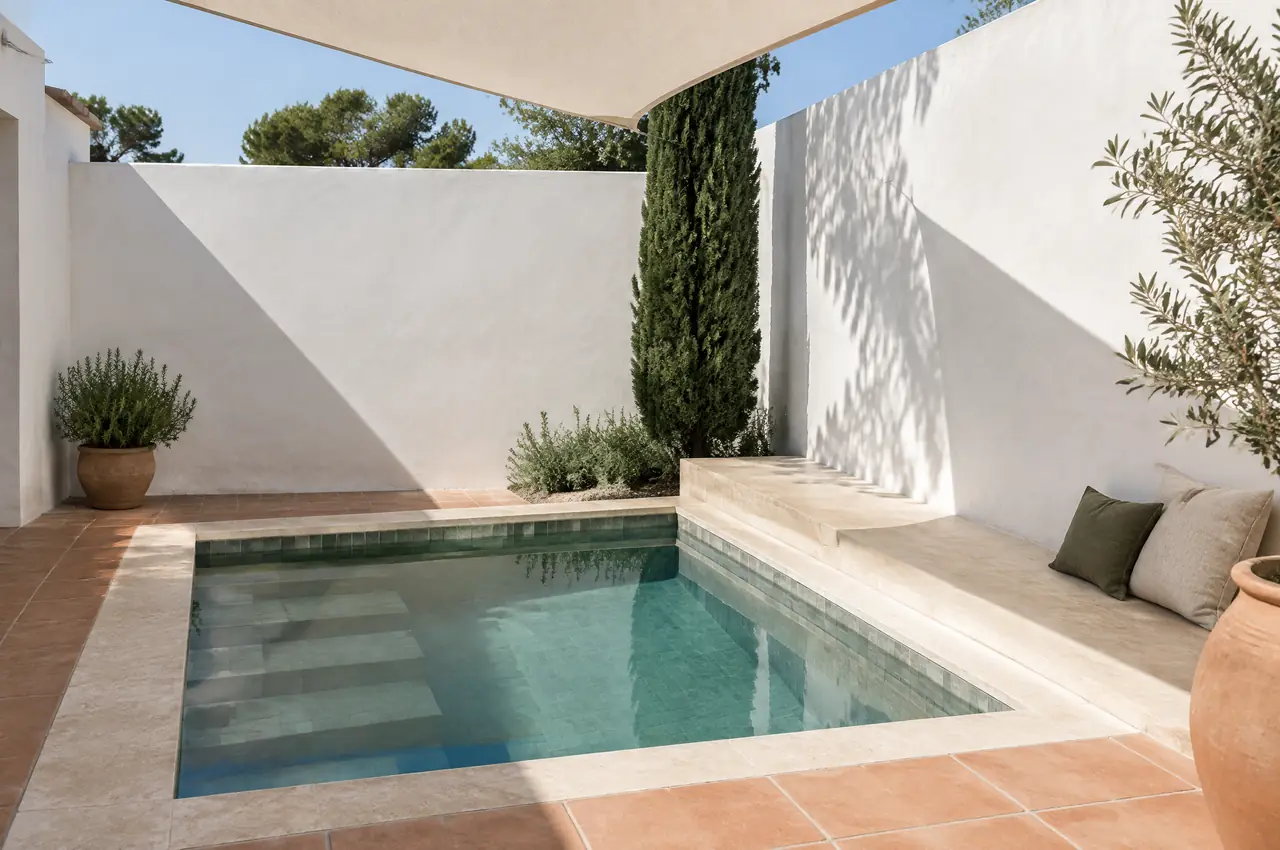
A built-in pool is surrounded by earth and paving, which stay cooler than the air and insulate the sides. A free-standing tub is exposed to the sun and the air on every face, and gains heat faster. That is why the same volume of water is easier to hold at 4 °C in a built-in pool than in a tub on a terrace, and why a tub in full sun wants a cover, shade and a class of chiller more than the minimum. See timber plunge tubs and free-standing ice baths.
Shade structures, compared
| Shade | Good for | Watch for |
|---|---|---|
| Fabric sail | quick, light, cheap | wind, and a sun that moves |
| Timber pergola with a reed or louvred roof | a permanent look, airflow | a south sun lower than the roof |
| A tree | free, scenic | roots, leaves, birds |
| A solid roof | complete shade | heat trapped under it if the sides are closed |
If the power goes off in August
A pool is a large store of cold. 1,100 litres of water absorbs about 1.28 kWh for every degree it warms. Suppose a covered, shaded pool gains 300 W from the air (our assumption for a hot afternoon, to be checked against your site): that is 7.2 kWh in a day, and the water warms by about 5.6 °C. A pool at 4 °C is at about 10 °C the next evening, which is still cold water. An uncovered pool in full sun gains about a kilowatt from the sun alone, more than three times as much, so the cover is the difference between a power cut you do not notice and one you do.
Pulling down at night
A chiller works against the air, so the first pull-down of the season is best done at night, when the air is cooler and the machine has the most margin. Start it in the evening, leave the cover on and read the display in the morning. If your tariff has cheaper night hours, the energy is cheaper too. After that the chiller only holds the temperature, and how hard it works depends far more on the cover and the shade than on the hour.
A checklist before August
- The cover fits and one person can lift it.
- The chiller's air path is clear: no boxes, no plants, no bins against the louvres.
- The coil is clean (rinse it with fresh water; salt and dust are the usual deposits).
- The filter is clean and the pump is running.
- The setpoint is where you want it, and the display agrees with a separate thermometer.
See chiller systems for the classes, plunge pools for the pools they serve, and the areas for what each place adds.
Can a plunge pool stay at 4 °C when it is 40 °C outside?
Yes, with a chiller sized for that ambient, shade, a cover and an air path. Without them, no machine will manage it.
Is a bigger chiller always better?
No. A class that is too large cycles briefly and wears; one that is too small runs flat out. The class follows the litres, and shade follows the sun.
What does it cost to run?
That depends on the tariff and the weather. A 4 HP unit draws about 3.6 kW while it runs, and it cycles. See glass sauna insulation and energy for how we work out a session.
Further notes
Notes that continue this one
Salt air on timber, glass and steel
Where salt travels, why 316 steel, how timber ages and a yearly checklist for coastal saunas.
Read on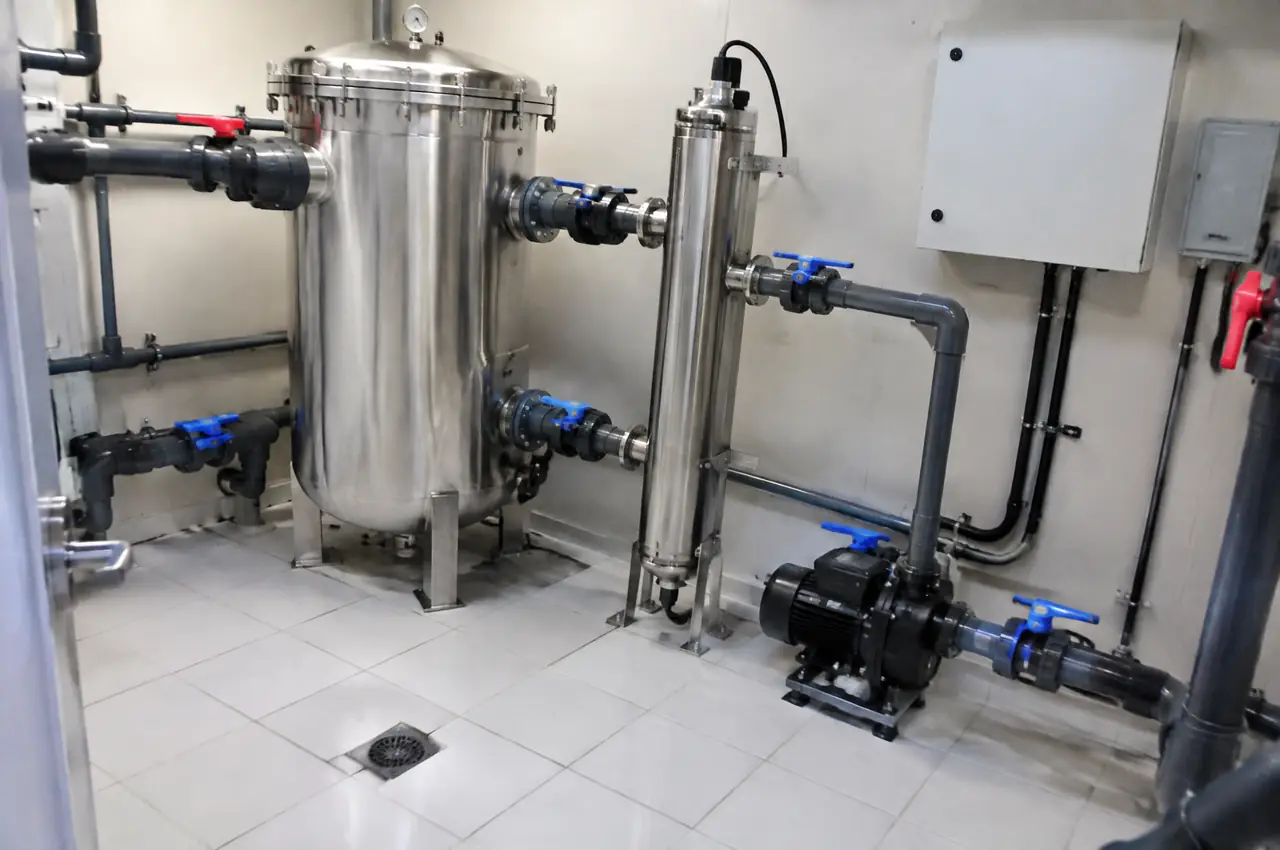
Keeping a shared plunge pool clean
Filtration, UV, ozone and chlorine, bather load, water changes and the log sheet that proves it.
Read on
From sea swimming to sauna and cold dip
The Irish habit, the cabin and cold dip it asks for at home, the deck that makes it work in November.
Read on