Collection · 02 · Hot and cold circuits
The hot and cold pool pair: 38 °C on one side, 4 °C on the other
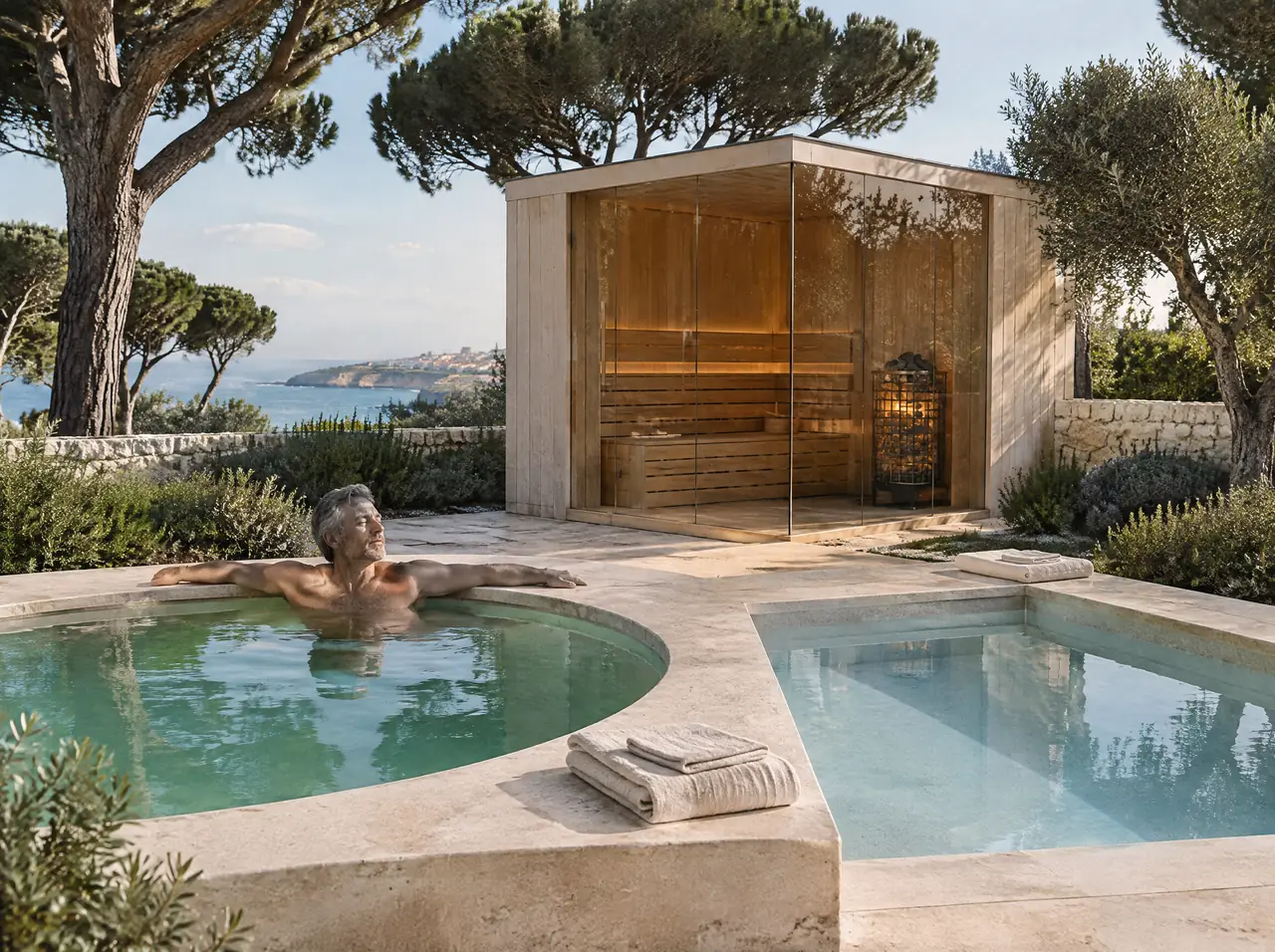
Two small pools sharing one coping and one plant room. One is held at 38 °C, the other at 4 °C, and the whole ritual happens within three steps of the sauna door, or with no sauna at all. It is the format that asks the least from the building and does the most for a terrace used in two seasons.
Sections on this page
A pair, not a pool plus a gadget
The idea is old and Nordic: warm, then cold, then rest, repeated. What is new is putting both ends of it in the garden of a villa in Marbella or a hotel in the Algarve, in the same drawing, with the same stone around the water. The warm pool is a small round soak held at 38 °C. The cold pool is the plunge pool described on its own page. They share a coping, so you step across rather than walk, and they share a plant room, so there is one set of pipes to inspect rather than two.
The honest seasonal arithmetic
A 38 °C pool in an Andalusian August is the least wanted object on the terrace: the air is already there. The same pool in a Kerry November is the best one. So the pair earns its keep differently by coast. Our rule of thumb, a judgement and not a statistic:
| Coast | Warm pool is wanted | Cold pool is wanted | What that means |
|---|---|---|---|
| Costa del Sol, Algarve, Cyprus | October to May | April to November | the pair is a shoulder-season and winter feature; the cold side works nearly all year |
| Mallorca, Ibiza, Valencia | October to April | May to October | autumn and spring evenings call for the warm side; July belongs to the cold |
| Lisbon, Porto, Madeira | most of the year | May to October | a balanced pair; Atlantic evenings are cool even in summer |
| Ireland | all year | all year, for people who swim in the sea anyway | the warm side is the draw; the cold side is a convenience |
If you let your property, this table is the argument for or against the warm pool. In February the warm pool and the sauna make a terrace usable; in August the cold side and the shade do.
How the three pieces sit together
- Sauna, warm pool, cold pool in a line. The sauna door, then the cold pool, then the warm pool: the classic order. Fits a long terrace.
- Pools side by side, sauna behind. The compact layout from our images: a shared coping, the cabin set back at the end. Fits a square courtyard.
- Pools without a sauna. A pair on its own is a complete small spa when the building has no room, or the guest brief says no heat. It is also the cheaper way to begin: the sauna can follow in a second phase on the same plant room.
Where the heat goes
A chiller is a heat pump pointing the wrong way for a house: everything it takes out of the cold pool has to go somewhere. On a pair, “somewhere” could be the warm pool. Whether that works on your site depends on the pipe runs, the pool volumes and the season, so it is a question for the 3D layout, not something to promise from a brochure. What we can promise is that the two pools are drawn together and the plant room has room for either answer.
Going from a warm pool to cold water is not for everyone. Anyone with a heart or blood-pressure condition, anyone who is pregnant and anyone who is unwell should ask a doctor before using the pools, and nobody should use them after drinking alcohol. In a hotel or club, the notice at the pool should say so in plain words.
How big the warm side should be
| Soaking for | Warm pool across | Typical use |
|---|---|---|
| two people | 1.6–1.8 m | a couple, a guest suite, a small villa |
| four people | about 2.2 m | a family villa, a holiday let that sleeps six to eight |
| six people | about 2.6 m | a boutique hotel courtyard or a club terrace |
These are working figures, drawn again for every site. The cold side barely changes with the number of people, because nobody stays in it for long; the warm side sets the footprint and the plant room.
A warm pool needs its own water care
A pool held at 38 °C is warm enough to need a disinfection routine of its own. In a hotel, club or let that means a written routine, regular readings and, where your health authority asks for it, a risk assessment for waterborne bacteria such as legionella. We size the filtration and the disinfection to the use; the readings and the rota belong to the operator.
Covers, drains and the evening routine
A warm pool left uncovered overnight loses heat to the air, so we draw a cover into every pair, either a flat lid or a sliding timber deck that doubles as a seat. Cold pools take a cover too: it keeps leaves and sun out. Both pools need a drain that reaches somewhere sensible, and a place for wet towels that is not the coping.
Can the warm pool be bigger than the cold one?
Yes. A warm soak for four needs about 2.2 m across; the cold pool stays small because it is for a minute or two at a time. The plant room grows with the warm side, not the cold.
Do I need a sauna as well?
No. A pair is a complete small spa on its own, and guests can alternate between the two pools. If you do want a cabin, see glass-front saunas.
What does a pair cost?
The indicative range is €18,000–32,000 for the two pools, the shared plant room equipment and basic installation. A sauna, decking and lighting are added from the price list.
Alongside
A pair wants a door to knock on
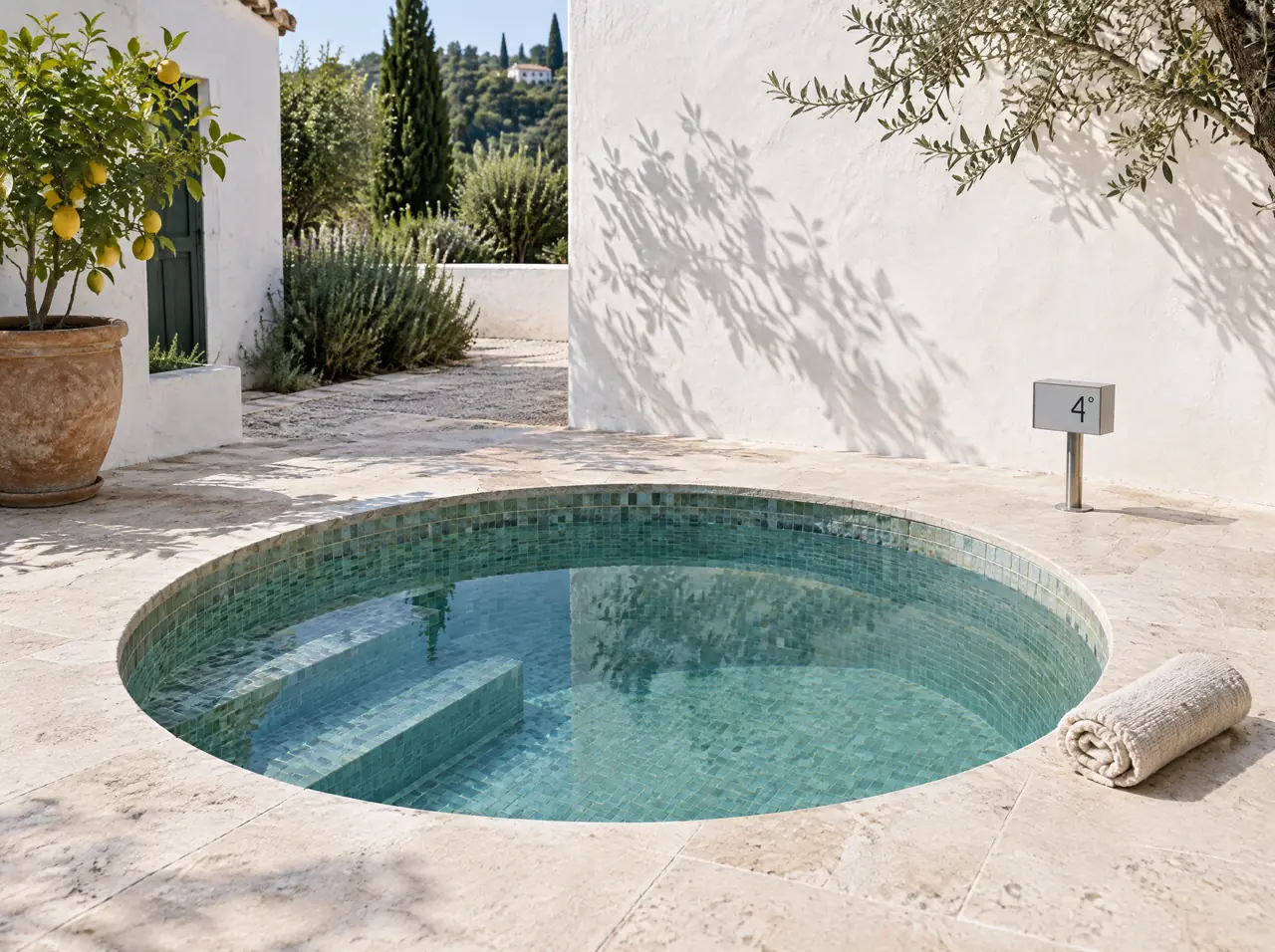
Cold plunge pools built into the terrace
Round or square, glass mosaic or tile, flush with the floor and held at 3–5 °C. The machinery stays out of sight.
Read on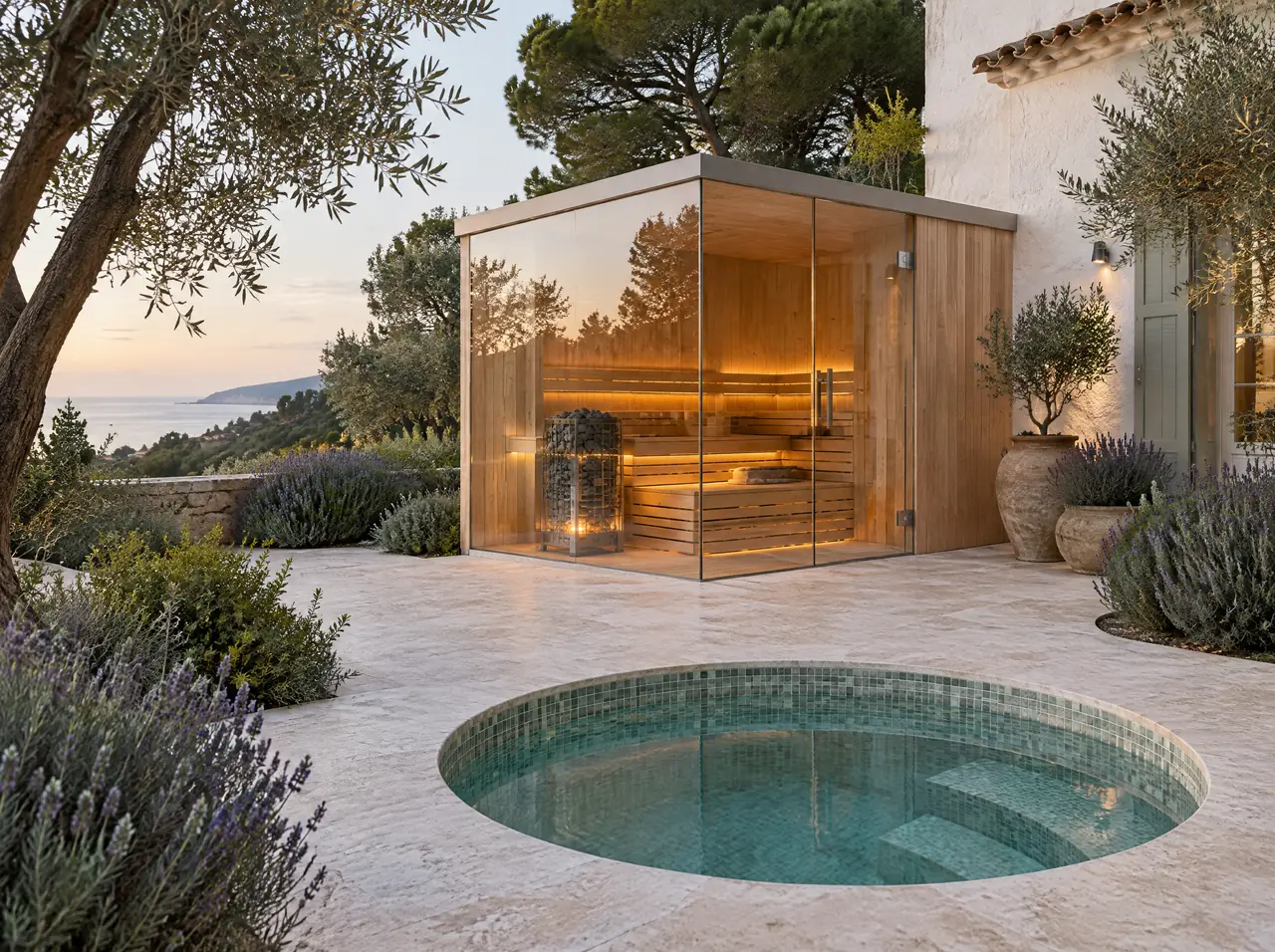
Glass saunas, one seat to twelve
One or two full glass walls, 1 to 12 seats, a Harvia heater and a view that fills the room.
Read on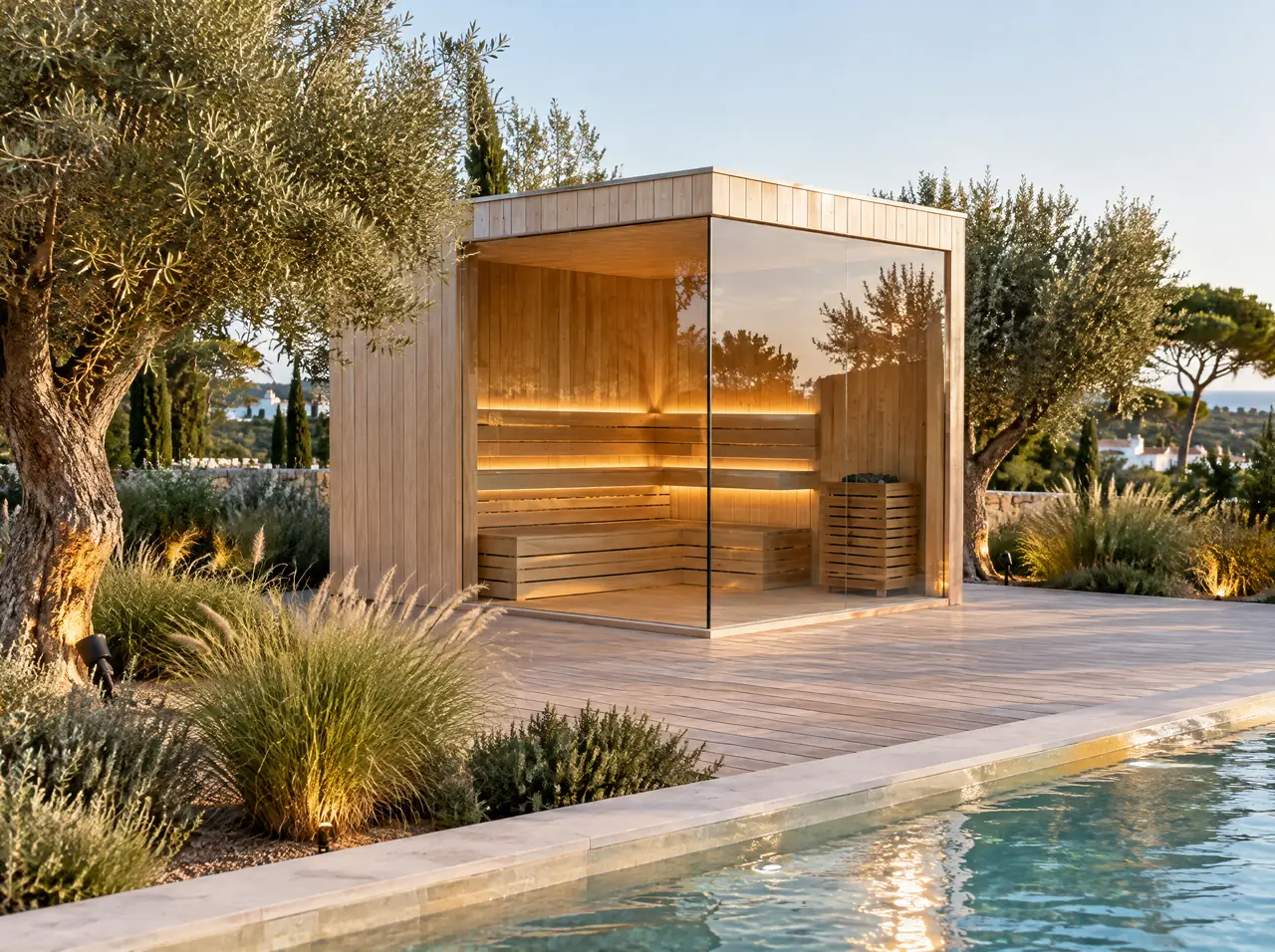
Outdoor saunas that stand on a deck
Free-standing glass-walled cabins for gardens, roof terraces and pool edges, built to weather sun, salt and storms.
Read on