Madeira · Funchal · PT
A sauna and cold plunge pool on Madeira, on black basalt above the Atlantic
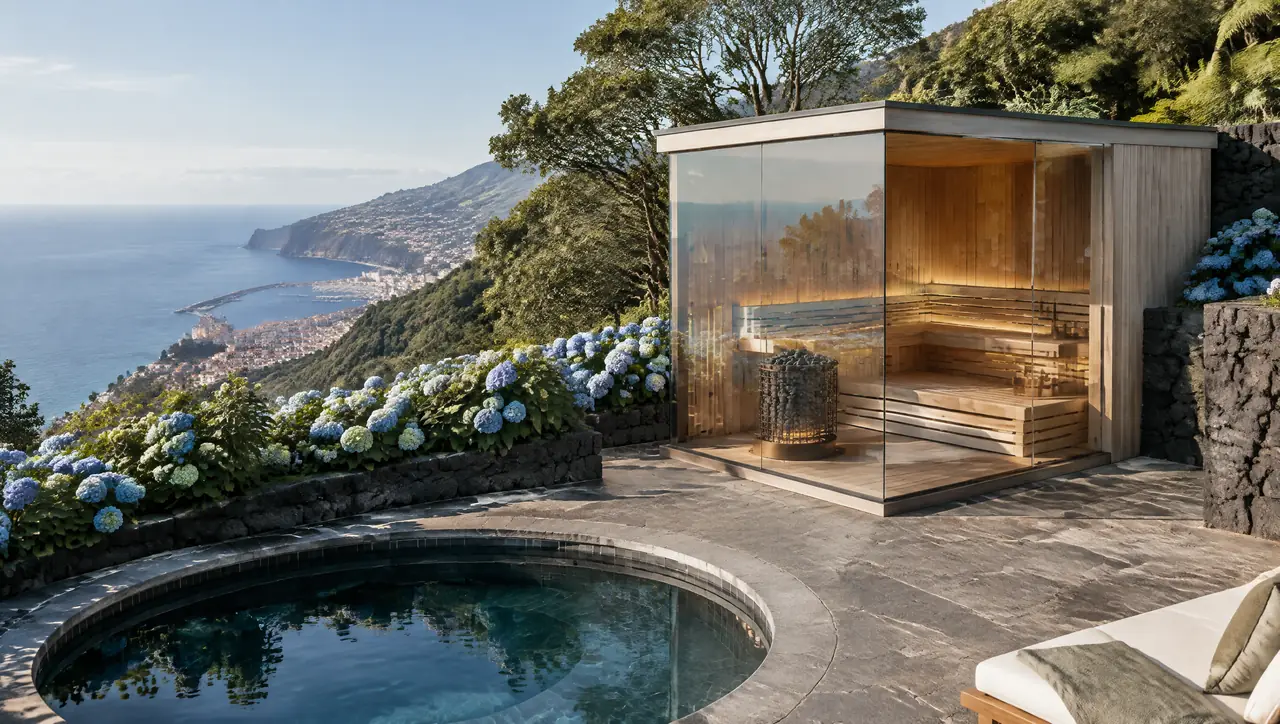
Terraces cut into steep hills, hydrangea hedges, laurel forest and the Atlantic far below: Madeira's mild year-round climate suits a cold pool in every month, and its steep sites suit a plunge pool far better than a swimming pool. The difficulty is the roads, the slope and the damp.
Sections on this page
- Why a plunge pool suits a slope
- Basalt, dark tile and hydrangeas
- Damp, rain and a cabin that dries
- Steep roads, a hoist and the last hundred metres
- Hotels and the mild year
- A sample for a terrace above Funchal
- Four mistakes a map will not warn you about
- Levadas, landslides and the line of the rain
- Funchal, the south coast and the north, compared
- Lifting a cabin up a Madeiran road
Why a plunge pool suits a slope
A swimming pool needs a flat plot, and flat plots on Madeira are rare and expensive. A plunge pool of 1.4 m across and 0.9 m of water fits a terrace carved into the hill, and a corner-glass cabin makes the view the centre of the garden. The compact footprint is what lets a pool fit on a terrace like that.
Funchal, Observatório (IPMA climate normal 1991–2020): a mean daily maximum of 25.4 °C in July and 26.8 °C in August, a January mean minimum of 14.3 °C and 574 mm of rain a year. Mild in every month, which means the chiller works all year and so does the salt.
Basalt, dark tile and hydrangeas
The terraces are built of black volcanic basalt and planted with hydrangeas and agapanthus. A pool in dark tile and a coping in basalt fit the walls; pale ash inside the cabin is the warm contrast. Salt and damp reach everything: ventilated cladding, drained bases, 316 stainless on all fixings and a routine for rinsing after storms.
Damp, rain and a cabin that dries
Madeira is humid, and the north side is wet. A cabin must be able to dry between uses: good ventilation, a membrane roof with a drip edge, a base off the ground and a door seal that is checked each year. In the drier south, around Funchal, the issue is sun and the plant room's air path.
Steep roads, a hoist and the last hundred metres
Crates arrive by sea from the mainland and are trucked up very steep, narrow roads. Some plots are reached by a track, and some by steps. We ask for the road's width and gradient, the turning space and whether a small crane or a hoist can be positioned. Where the road ends, the panels are carried by hand and the glass is lifted with suction lifters and four people.
Hotels and the mild year
Madeira has many hotels, and its climate is kind in winter. A wellness corner with a glass sauna and two plunge pools suits them in any month; the plant is drawn into the terrace structure. See boutique hotels and the notes on hygiene for commercial plunge pools.
A sample for a terrace above Funchal
Four mistakes a map will not warn you about
| Mistake | What follows | What we do |
|---|---|---|
| Planning the crates from a map | a lorry that cannot take the bend | ask for the road's width and gradient; plan a small crane or a carry |
| Ignoring damp | a cabin that never dries between uses | ventilated cladding, a base off the ground, a door seal check each year |
| Choosing a flat-plot pool | a swimming pool that will not fit the terrace | a plunge pool of 1.4 m, which does |
| Forgetting the Atlantic salt | browned steel within two seasons | 316 stainless on everything the air touches |
Levadas, landslides and the line of the rain
Madeira's hillsides are crossed by levadas, the old irrigation channels, and shaped by heavy rain that arrives in bursts. Water runs fast off steep ground and carries soil with it. A plant chamber at the foot of a slope is a poor idea; a terrace with a drain that can take a downpour is a good one. Ask the câmara about slope stability and drainage on the plot, and ask who owns the water that crosses it. We draw the pool and the plant above the line of the rain.
Funchal, the south coast and the north, compared
| Funchal and the south | The north coast | |
|---|---|---|
| Weather | sunnier, drier, warmer in summer | wetter, cloudier, more wind |
| What fails first | the chiller in a hot courtyard | timber that stays wet and seals that never dry |
| What we draw | shade, a clear air path, a pool cover | ventilated cladding, a drained base, a cabin that dries between uses |
| Typical site | hotels and villas above the bay | quintas, eco-lodges and retreats |
Lifting a cabin up a Madeiran road
- Crates leave the mainland by sea and arrive in Funchal or at another port.
- A small lorry takes them up the road; a larger one cannot manage the bends.
- Where the road ends, panels are carried by hand along the path, in blankets.
- The glass is the last thing lifted, with suction lifters and four people, never by one.
- A level base and an hour of dry weather decide whether the roof goes on that day.
Island freight is quoted in the layout; the equipment ranges are in the price list and the kit builder.
How do crates reach a steep plot?
By sea from the mainland, then by lorry, hand-carry or small crane, depending on the road. Send the width and gradient.
Is a plunge pool allowed on a terrace like mine?
That depends on the land and the câmara. Ask what the plot is registered as and whether a small pool is minor works.
Does the damp spoil a sauna?
Not if the cabin is ventilated and the base dry. We draw both.
Other coasts
The same drawing under a different sky
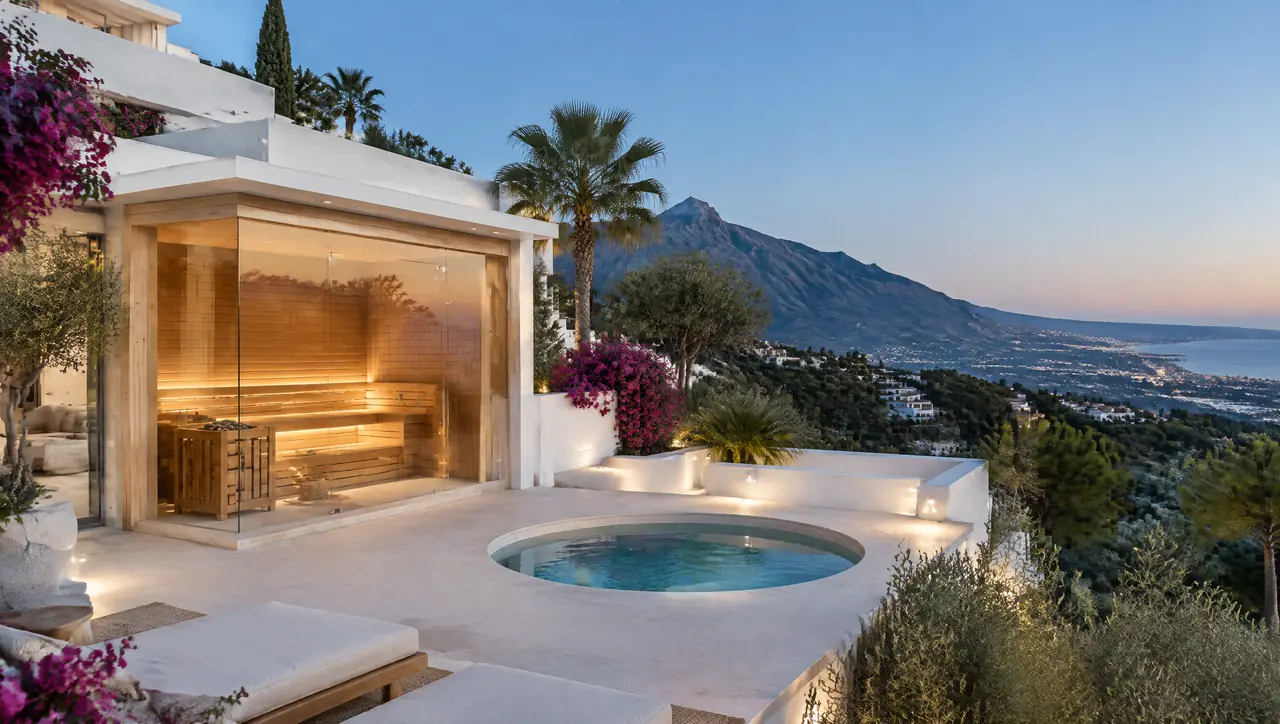
Marbella and the Costa del Sol
Villas, estates, hotels and padel clubs: a pool that stays cold when the terral blows.
Read on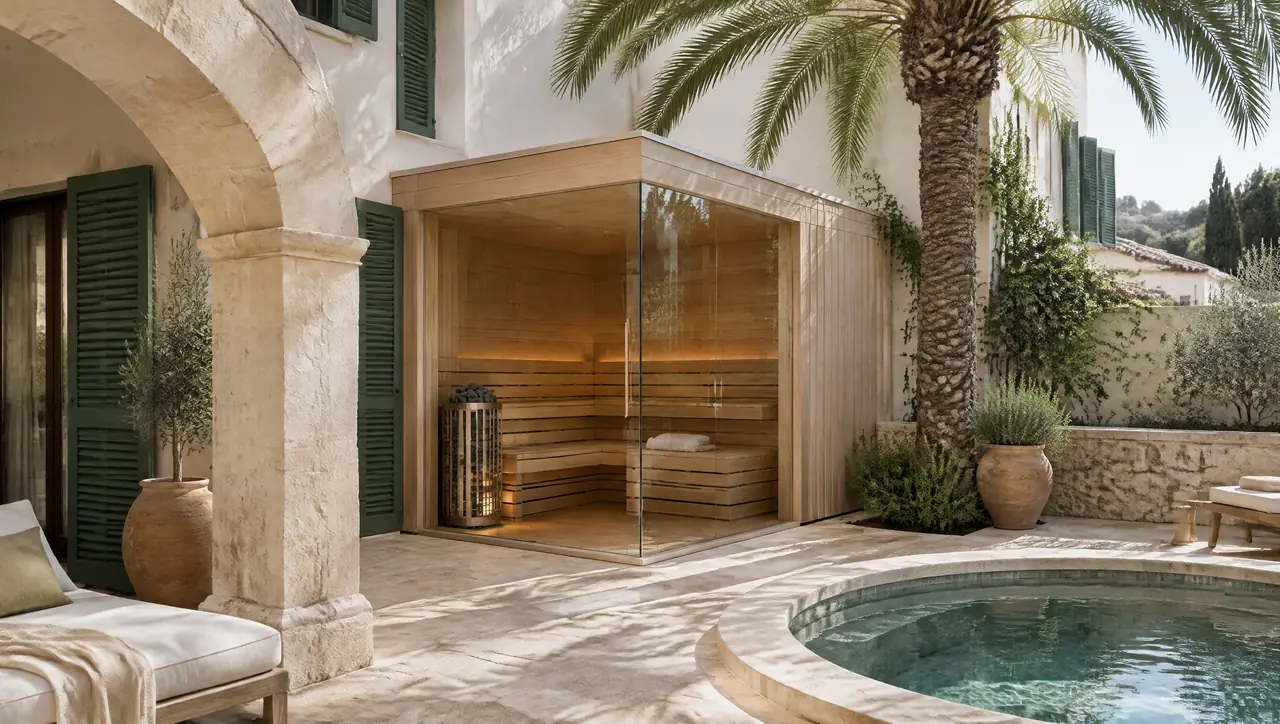
Mallorca
Fincas, Palma patios and hotels: stone, olive terraces, island freight and a plant that respects the water.
Read on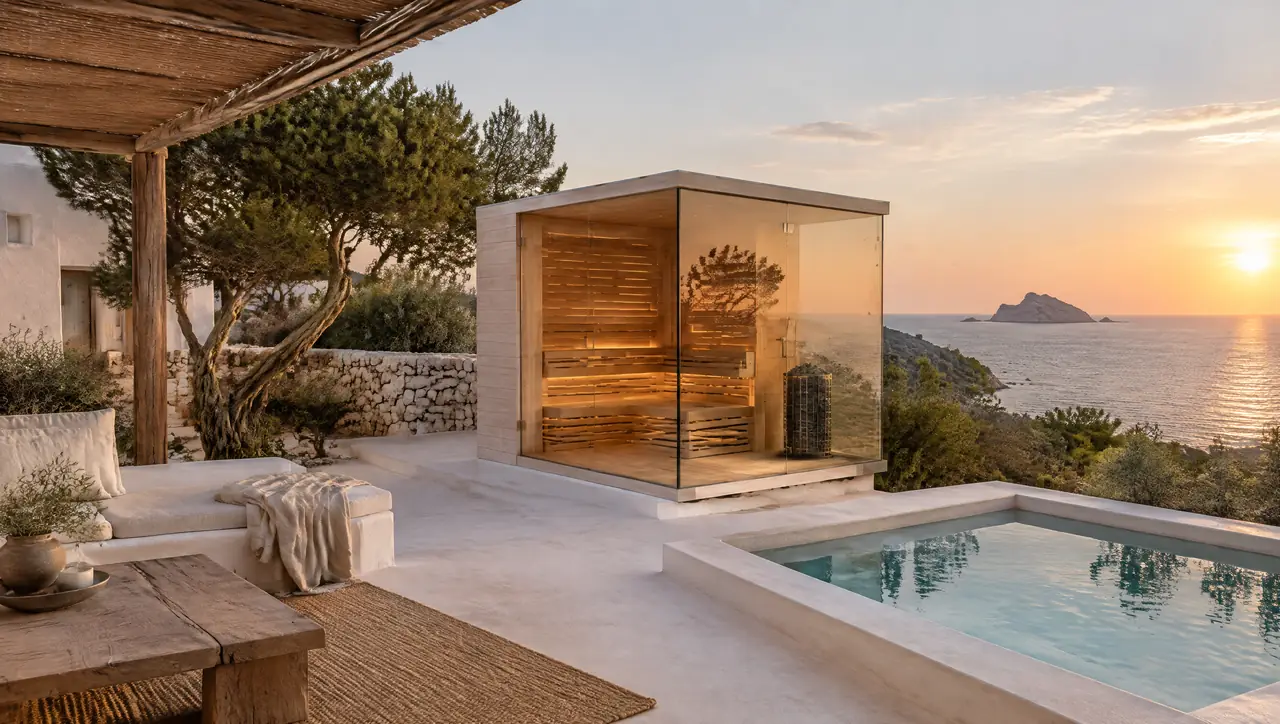
Ibiza and Menorca
Cubic villas, agroturismos and boutique hotels: islands that love a plunge pool and regulate what you build.
Read on