Collection · 03 · Glass-front saunas
The glass sauna: one wall of view, or two meeting at a corner
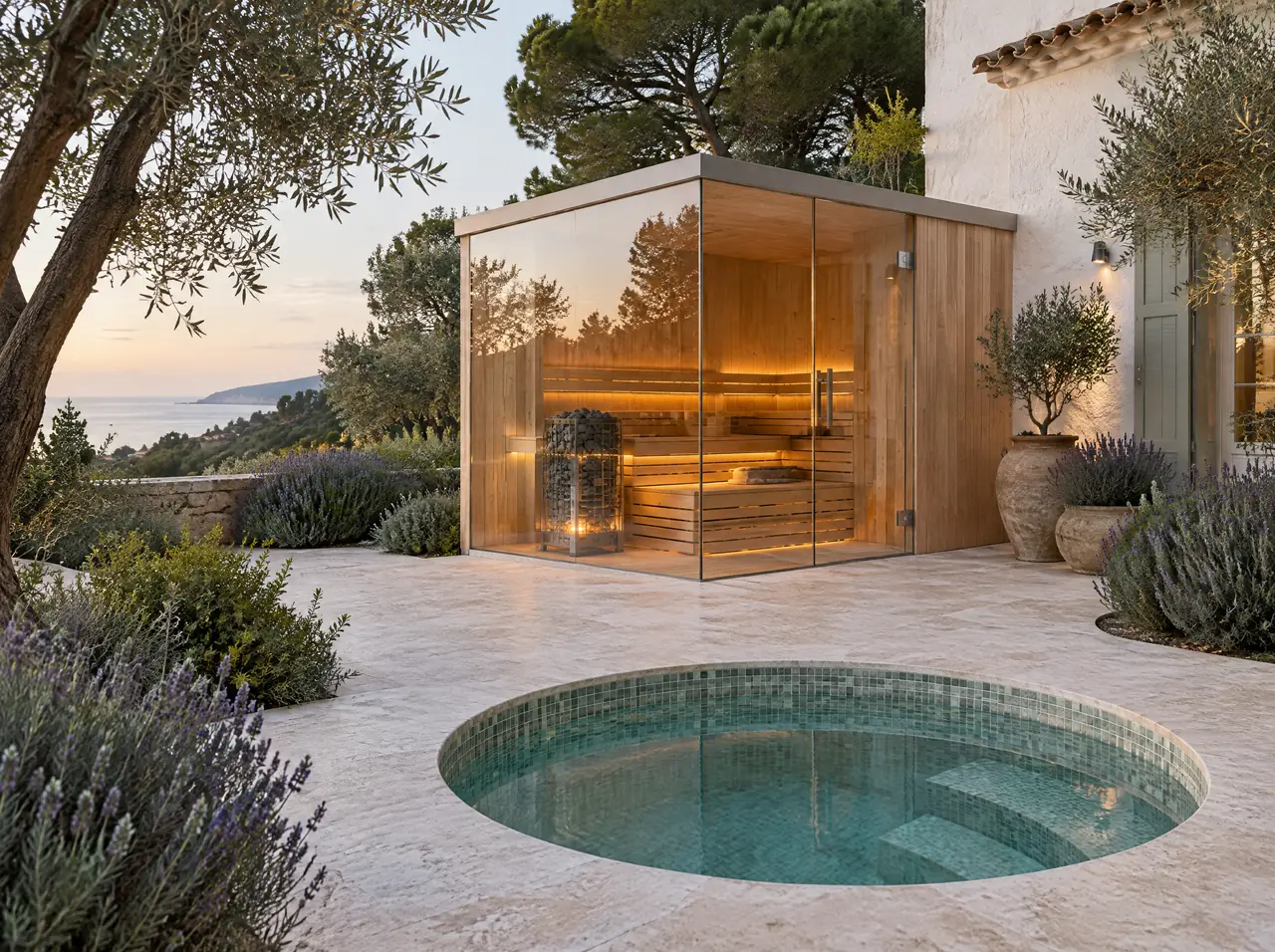
A sauna with a wall of glass is two rooms at once: a 90–110 °C cabin and a framed picture of the sea, the pines or the courtyard. We build them for one to twelve seats, always with at least one full-height glass wall, most often with two glass walls meeting at a corner.
Sections on this page
Why glass, and what it costs you in heat
Glass does three things timber cannot: it shows the garden, it makes a small cabin feel twice its size, and in a club or hotel it lets staff see the room without opening the door. It also loses heat quickly. Single toughened glass has a U-value of roughly 5.7 W per square metre per kelvin; an insulated timber wall is closer to 0.4. At 90 °C inside and 20 °C outside, a 2 m² glass wall gives up about 800 W, which is a lot of heater for a surface you cannot sit against.
So the heater is sized from the cabin volume and then raised for the glass, using the maker's tables. It is one of the details that separates a glass sauna that reaches 90 °C in about forty minutes from one that never quite gets there. The glass-and-energy note has the arithmetic.
One glass wall with the door, or two at a corner
- One full glass wall with the door. The sober version: the door and a fixed panel in one frameless plane, three solid timber walls behind you. Best against a wall, in a spa room, or where the neighbours are close.
- Two glass walls meeting at a corner. Our usual drawing. The corner opens the cabin to a diagonal view and takes the room's darkest angle and turns it into its brightest. Best on a terrace and at the edge of a garden.
- Glass door only. A cheaper step for cabins inside a bathroom or basement, where there is nothing to look at. Still a glass door, never a solid one.
From one seat to twelve
| Seats | Cabin (plan) | Heater | Indicative range |
|---|---|---|---|
| 1 | 1.4 × 1.2 m | Harvia 3.5 kW | €5,300–7,100 |
| 2 | 1.6 × 1.4 m | Harvia 4.5 kW | €7,100–9,700 |
| 4 | 2.0 × 1.8 m | Harvia 6 kW | €9,700–14,000 |
| 6 | 2.4 × 2.2 m | Harvia 8 kW | €14,000–19,500 |
| 8 | 3.0 × 2.4 m | Harvia 10.5 kW | €18,500–26,000 |
| 10 | 3.4 × 2.6 m | Harvia 15 kW | €22,500–31,000 |
| 12 | 4.0 × 2.8 m | Harvia 18 kW | €27,000–37,500 |
Up to six seats is a household. From eight seats the project is usually a business, and the heater is a three-phase machine: see villa mains or three-phase before you choose a cabin for a club.
What is behind the glass
Two levels of slatted benches in pale cedar or thermally modified ash, with aspen or ash backrests that stay comfortable to touch. A Harvia heater with a stone basket, a bucket and a ladle, a thermometer and a hygrometer on the wall, and low lighting behind the benches. The door is toughened glass in a frameless leaf. It opens outward and has no lock a bather can be trapped behind: by convention and by common sense, that is how a sauna door works.
Specifying the glass: five lines to ask for in any quote
- Glass type and thickness, and that it is toughened safety glass. Ask for the declaration of conformity.
- Edge and corner treatment. Polished edges, and a corner joint that is sealed and supported rather than just butted.
- Hinges, handle and fixings in stainless steel, marine grade if the cabin is within a few kilometres of the sea.
- Door seal and threshold. The door should close on a seal that survives heat and does not trap water.
- The swing. A drawing showing which way the door opens and what it clears. A sauna door opens outward.
Looking after glass in a sauna
The glass fogs a little when the cabin cools and clears as it heats; that is physics, not a fault. Clean it with a microfibre cloth and a mild cleaner, never with abrasive pads, and wipe the seals now and then. Near the sea, check the hinges and fixings once a year: they should be stainless steel of marine grade. Salt air, timber, glass and steel lists what to look at.
Each size has its range in the price list; the kit builder shows what a cabin and a plunge pool come to together, with the heater and the chiller already sized.
Can a glass sauna go outdoors?
Yes, and it is our usual outdoor drawing. The cabin must be insulated like a small house, with a roof that sheds water and a base that does not hold it. See garden saunas.
Is it safe to have glass in a hot room?
The glass is toughened safety glass, made to take the temperature and to break into small blunt pieces if it ever fails. Ask for the glass specification and its declaration of conformity in the quote.
Why do the heaters get bigger with glass?
Because the glass is the coldest surface in the cabin. The heater has to feed the room and the glass at the same time, and we size it for both.
Alongside
Water for after the heat
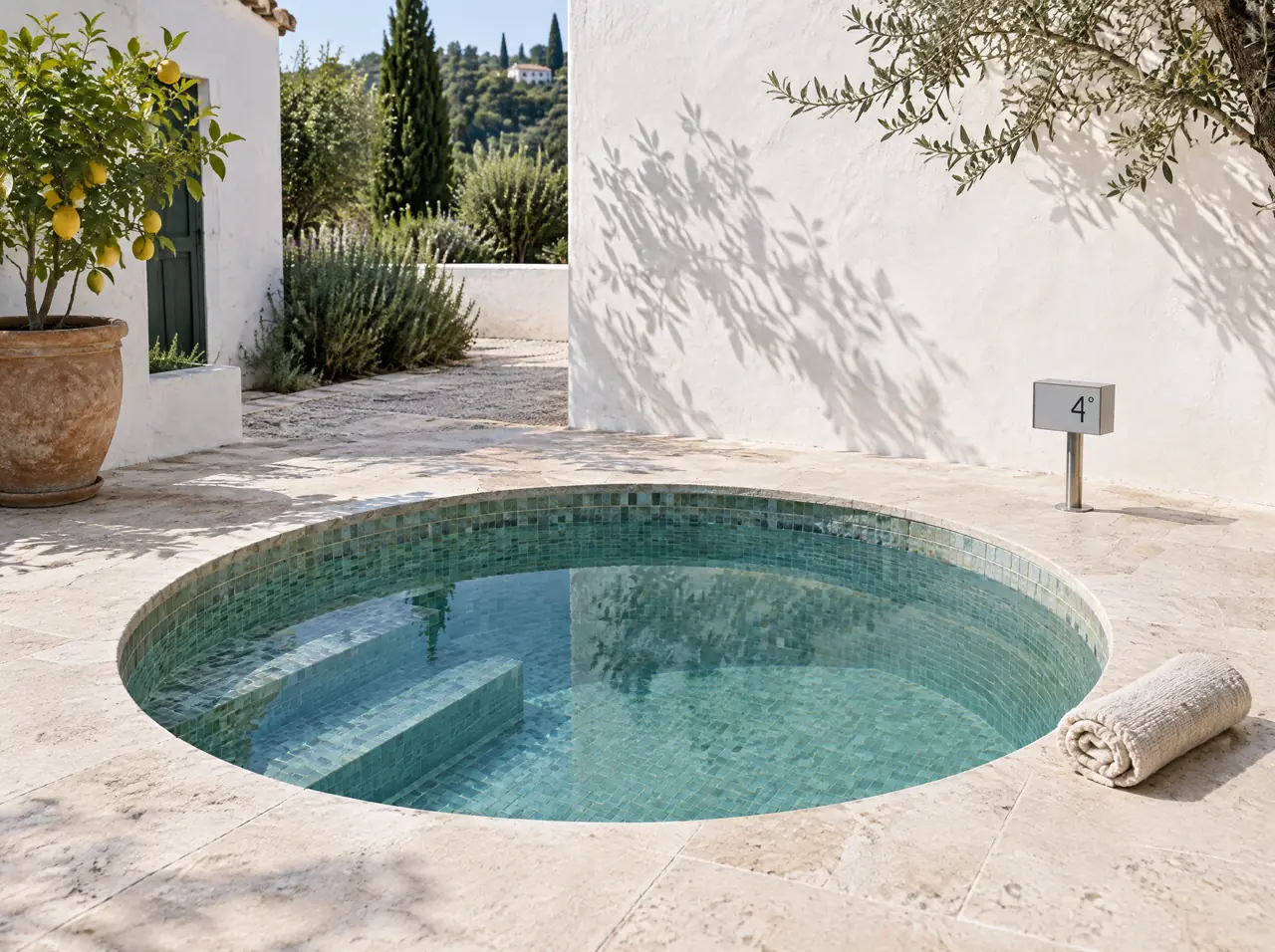
Cold plunge pools built into the terrace
Round or square, glass mosaic or tile, flush with the floor and held at 3–5 °C. The machinery stays out of sight.
Read on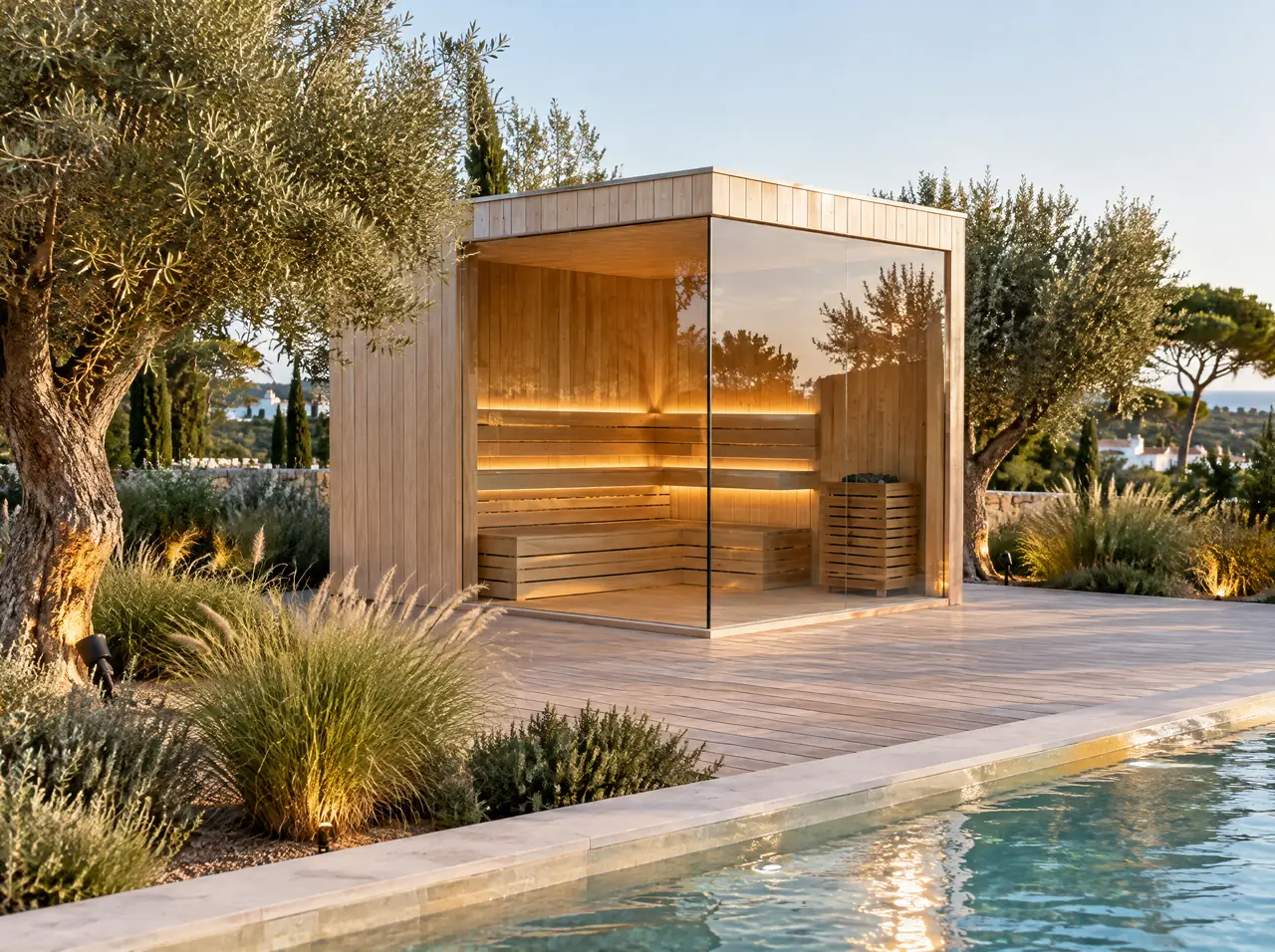
Outdoor saunas that stand on a deck
Free-standing glass-walled cabins for gardens, roof terraces and pool edges, built to weather sun, salt and storms.
Read on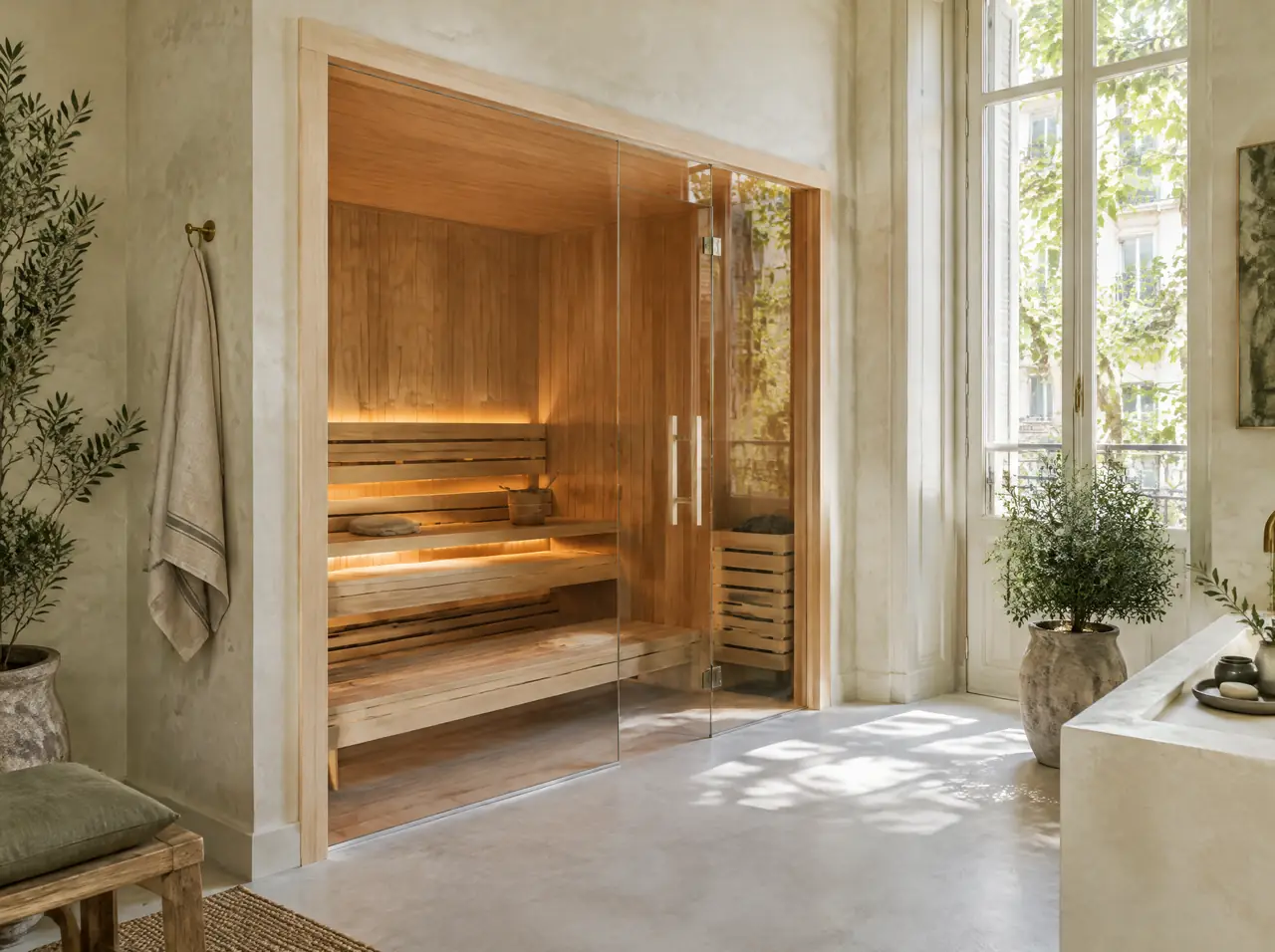
Custom saunas cut to the room
A dry sauna sized to the alcove, basement or bathroom you have, from one seat to twelve.
Read on