Collection · 01 · Plunge pools
A built-in cold plunge pool that looks as if it was always part of the terrace
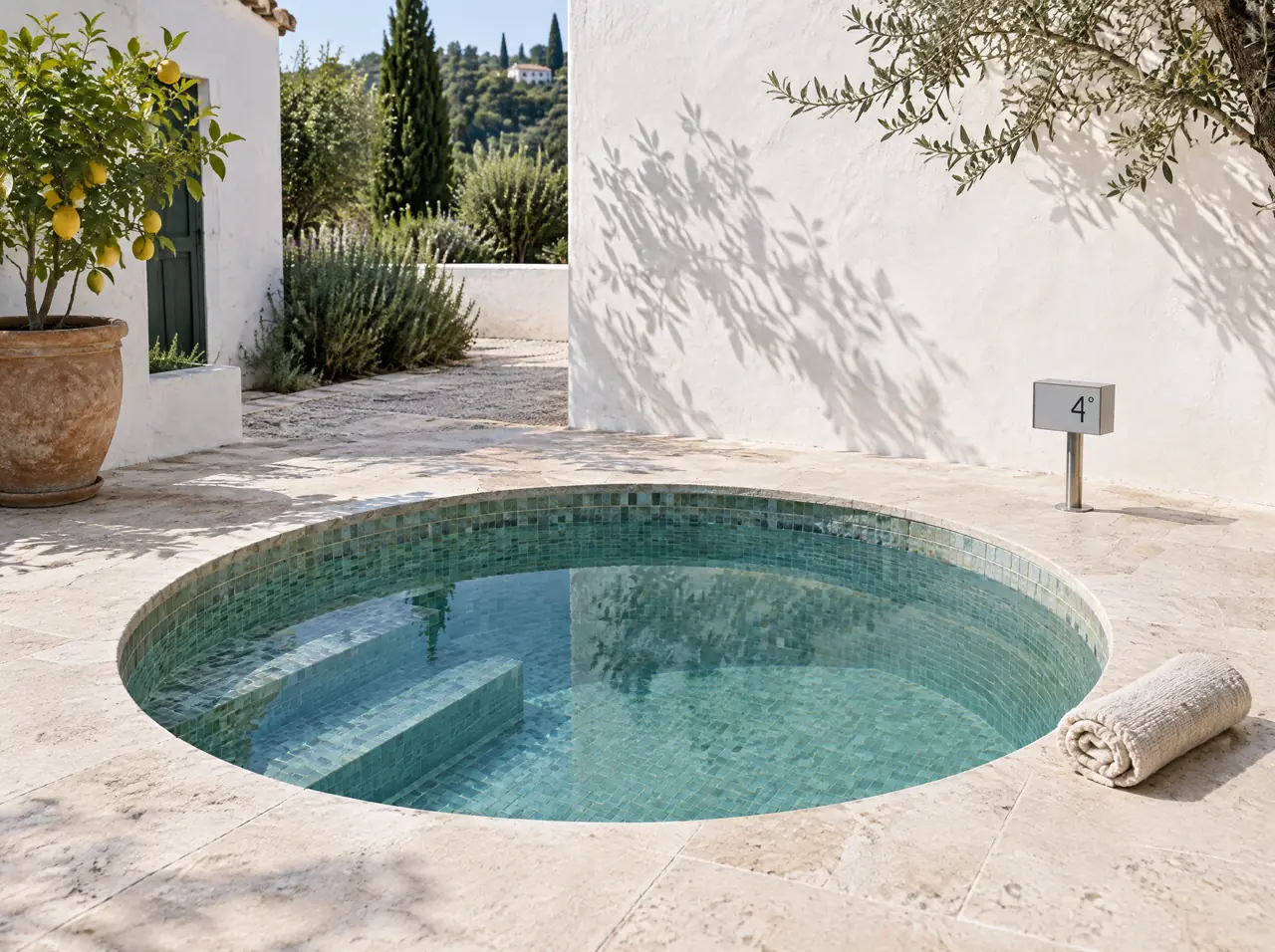
Not a barrel and not a bathtub: a small, properly built pool about 1.4 m across, with two underwater steps, a finish you choose and water held at 3–5 °C through a Mediterranean August. The chiller lives in a niche, a plant room or underground. At the water's edge there is a folded towel and one small display.
Sections on this page
What you see, and what you do not
The visible part is modest. A basin of 1.4 m, round or square, in mosaic, tile or stone, set flush with the paving or raised to a seat-height rim, with two steps you can find with your feet. A small plain display on a short post shows a single number: 4. Everything else is somewhere else. The chiller, the circulation pump and the filter sit in a ventilated niche, a plant room or a buried chamber, joined to the pool by insulated pipes.
That separation is the whole design. A cold pool that has to look good in a hotel courtyard cannot also be a machine room, and a machine that has to breathe in 38 °C air cannot be bricked in behind a pool wall. We draw the two apart first and connect them afterwards.
Shapes, sizes and the seat you did not know you needed
- Round, 1.4 m across (about 1,100 litres). The easiest shape to line in small mosaic, because the tile follows the curve without cutting, and it fits where a hot tub would not.
- Square, 1.4 × 1.4 m with a seat-height coping (about 1,200 litres). The shape that suits a straight-lined terrace. The broad coping on one side is the bench people sit on before they lower themselves in.
- Long and narrow, drawn to fit. The old irrigation tank of a finca (the alberca in Andalusia, the safareig in Mallorca) can make a very good plunge pool at 1.0 × 3.0 m with the steps at one end: about 2,400 litres and two 4 HP chillers.
- Corner and step-down variants for terraces with an awkward corner or a change of level: send the plan.
The water is about 0.9 m at the deepest point, shoulder-deep for most adults sitting on the lower step. The steps take up part of the volume, which is how a 1.4 m pool comes to about 1,100 litres.
Sizing the chiller for a 38 °C afternoon
The water is the easy part: 1,100 litres at 4 °C is a modest load. The air is the hard part. A chiller throws heat into the air around it, and on a terrace in Seville or Limassol that air can be 38–40 °C. We design the Mediterranean pools for that ambient, not for a showroom in Helsinki, and we size by the litres in the basin:
| Water held at 3–5 °C | Chiller class | Typical pool |
|---|---|---|
| up to 260 litres | 1 HP | a compact tub |
| up to 570 litres | 2 HP | an oval or round tub |
| up to 1,200 litres | 4 HP | the round and square pools above |
The first fill is the biggest job. Taking 1,100 kg of water from a 24 °C hose down to 4 °C means removing about 26 kWh of heat (1,100 kg × 4.19 kJ per kg per kelvin × 20 K), so the first pull-down is overnight work. After that the chiller only holds the temperature, cycling on and off, and a cover or a shade sail stops the afternoon sun doing the chiller's job in reverse.
Finishes that live with salt, sun and wet feet
Glass mosaic reads as water: sea-glass green sets the tone in a Mediterranean courtyard, slate grey suits Atlantic light. Porcelain tile is quieter and easier to replace. Stone coping (travertine, limestone, basalt) needs a non-slip finish, and the steps should grip at least as well as the coping: ask your builder which slip-resistance class applies to wet barefoot areas where you live. Near the sea, every metal part that touches the water or the salt air, such as the handrail, the anchors and the drain grate, should be 316 stainless steel.
The indicative range covers the finish materials, the chiller, circulation, filtration and basic installation. The basin itself, with its waterproofing, is built by your contractor to our drawings. The basin's structure, groundworks, the structure of a plant room and the electrical supply to it are priced from your site. Delivery is allowed for in the range; the exact figure comes with the 3D layout.
Home pool or hotel pool: two different jobs
A private plunge pool is used by a household. A pool in a boutique hotel, a padel club or a clinic is used by strangers, in numbers that set the rota, and becomes a hygiene question as much as a cooling question. The shell can look identical; the plant behind it cannot. It needs filtration sized to the number of bathers, disinfection you can document, a plan for water changes and a cleaning rota. Read hygiene for commercial plunge pools before you write the brief for a hotel.
What we need from you before we draw anything
- Photos of the terrace from two corners, and a plan with dimensions. A phone sketch is enough.
- Where the water can drain to, and the level of the nearest drain.
- Where the machinery can go: a niche or room as close as possible to the pool, with air coming in and going out. Every metre of pipe is heat gained.
- Whether the supply is single-phase or three-phase, and the amps left at the board. A 4 HP chiller draws about 3.6 kW, roughly 16 A on a 230 V single phase.
- Access for the crates: door widths, stairs, whether a crane is possible.
- Any rules from your community, town hall or hotel brand.
The firm quote follows from the layout, not the other way round.
To put a number on it, the price list has the round and the square pool with their chillers, and the kit builder adds a cabin and shows the range for the whole circuit.
How cold is a cold plunge pool?
Our standard setpoint is 3–5 °C, held within ±0.3 °C. The setpoint is adjustable, so a gentler start is possible.
Can a plunge pool be added to a terrace that already exists?
Usually yes, provided the slab can be cut and the water has somewhere to go. The basin is a short building job; the plant room is the part that needs thought. Send the plan on WhatsApp.
Do I need planning permission for a plunge pool?
It depends on the country, the region and sometimes the street. Some places treat a small pool as minor works, others as a pool with its own licence and safety rules. Ask your town hall exactly that, and use the permits note for the questions to put to them.
Does the pool need ice?
No. “Ice bath” is only the name. A chiller holds the water at 3–5 °C without any ice, and the surface stays smooth and clear.
Alongside
The pool is half of a pair
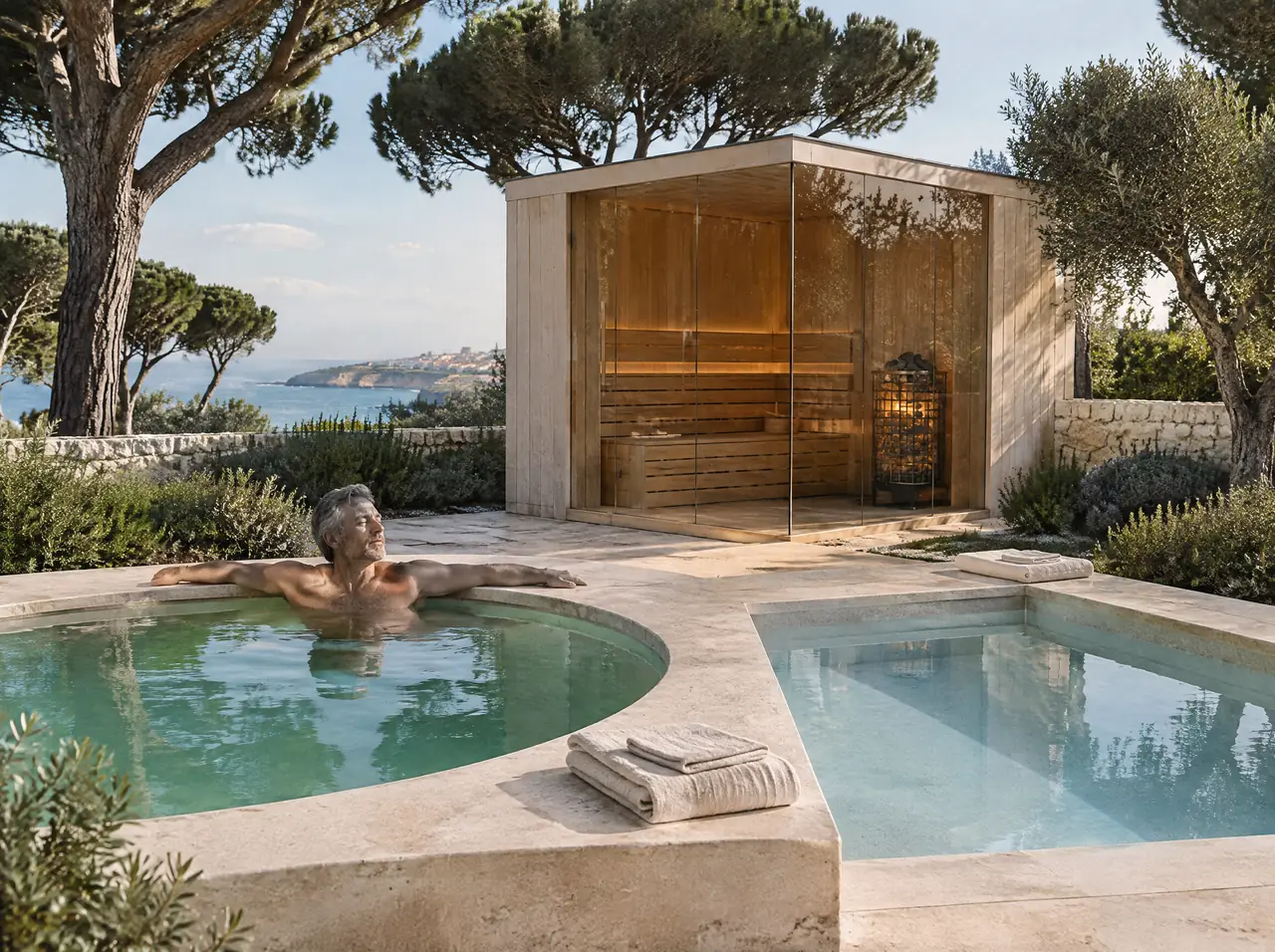
Warm pool, cold pool, one plant room
A 38 °C pool and a 4 °C pool side by side, with a sauna or without. One plant room, one drawing.
Read on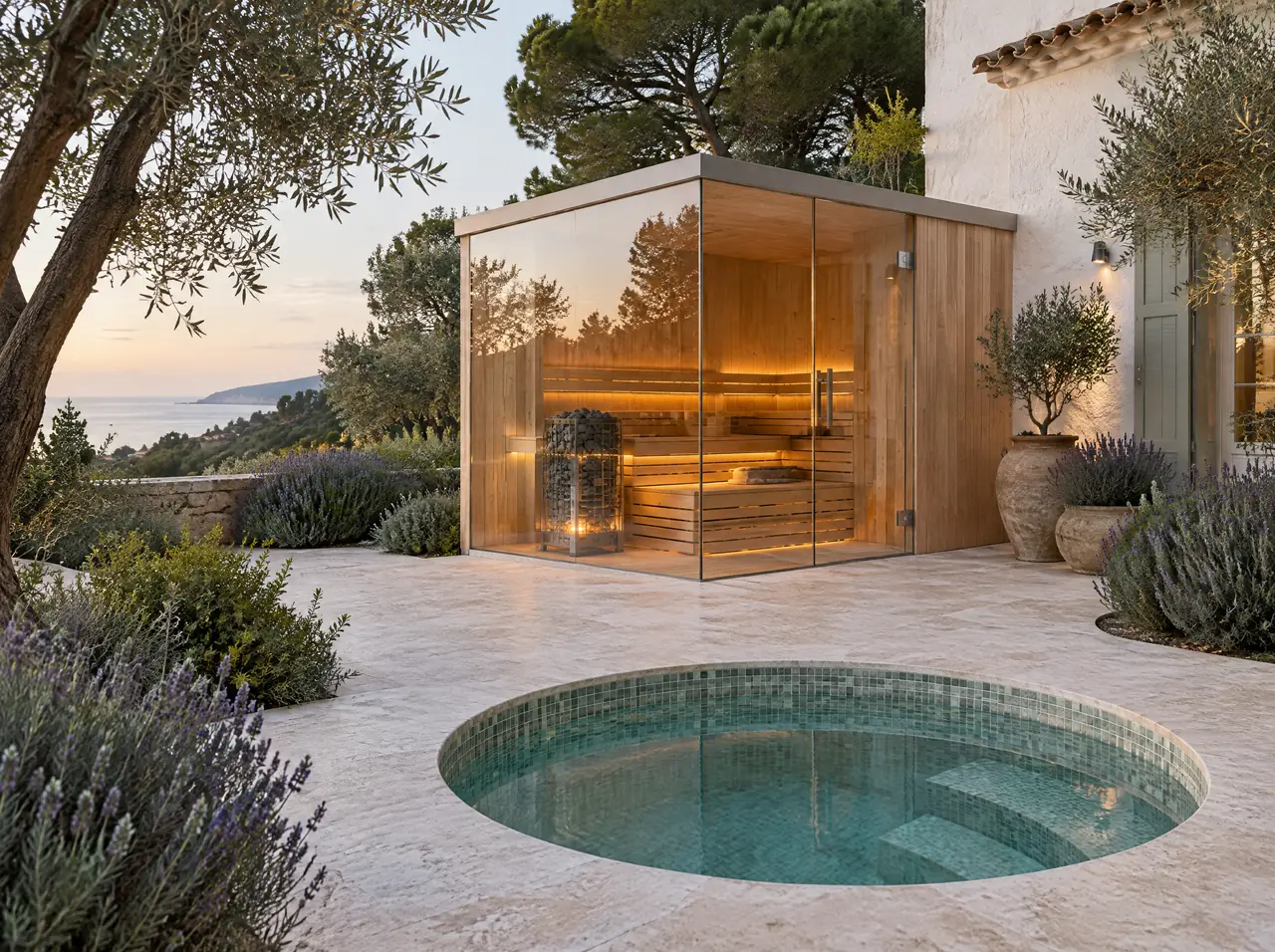
Glass saunas, one seat to twelve
One or two full glass walls, 1 to 12 seats, a Harvia heater and a view that fills the room.
Read on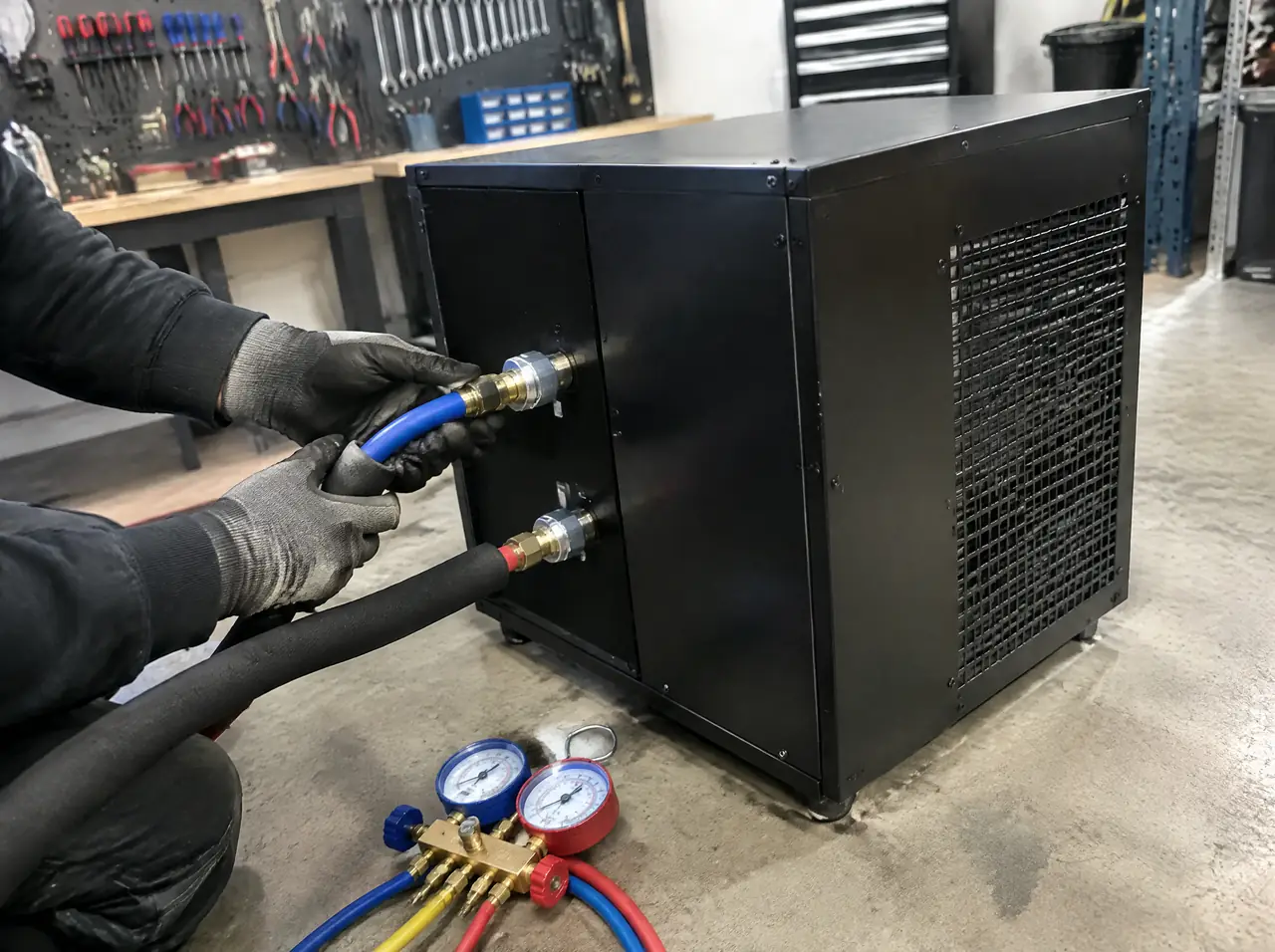
Chillers sized by the litre
1, 2 and 4 HP classes sized by litres, with filtration and controls, drawn into a niche or plant room.
Read on