Galway · Connemara · IE
A sauna and cold plunge pool in Galway and the west, on bog, rock and open water
Connemara's lakes and heather, the limestone of the Burren, the Aran ferries, Salthill's promenade full of swimmers: the west is the most exposed of our Irish places. The ground is peat or stone and the wind is unobstructed. A cabin here has to be anchored like a boat.
Sections on this page
- Bog, rock and what stands on them
- Anchored like a boat
- Salthill and the swimmers of the bay
- Lodges, hotels and farm stays
- Islands and ferries
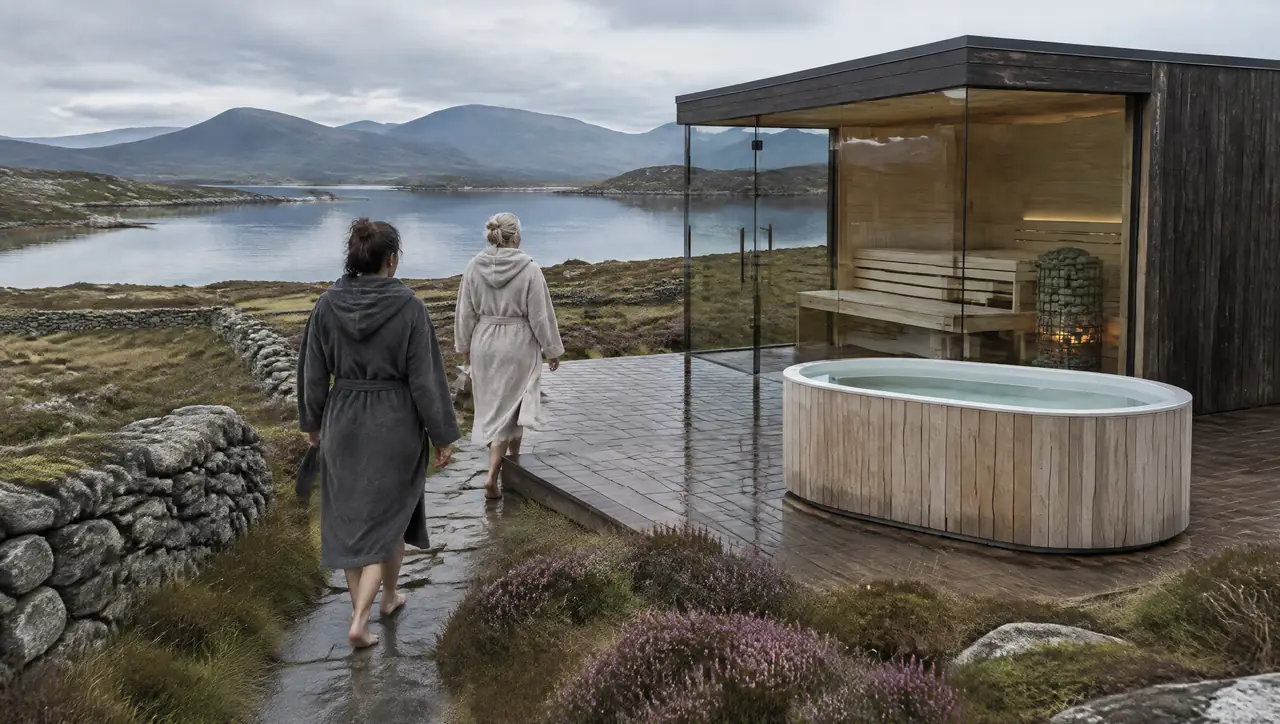
- A sample for a lough-side cabin
- Seasons on the Atlantic edge
- What the west does to a careless drawing
- Peat, anchors and a ground investigation
- What we need to know about a plot in the west
Bog, rock and what stands on them
Much of Connemara stands on blanket bog, peat that compresses and drains slowly, and the Burren in north Clare on limestone pavement that does not take a post at all. Both ask for the base to be designed first: a slab or a set of piles on peat, anchors drilled into rock, a deck that spreads its load. A ground investigation or a local contractor's knowledge saves more money here than anywhere else we work. We ask for it at the start, not at the end.
Shannon Airport is the nearest Met Éireann station we checked to Galway: its 1991–2020 figures are 1,019.7 mm of rain a year, a July mean daily maximum of 19.5 °C and a January mean daily minimum of 3.3 °C, and Valentia on the Atlantic edge has 1,646.5 mm. The west is wetter than Dublin by a good margin, and the wind adds to it.
Anchored like a boat
With nothing between the cabin and the Atlantic, the wind is the first design load. The cabin is low, flat-roofed and tied to its base, the deck is tied to the ground, and the glass is toughened and sized for the exposure. A cover on the plunge pool must be lifted in a gale by one person and weighted so it stays down. Everything that can be unscrewed is stainless, and the first thing we check after a storm is the roof edge.
Salthill and the swimmers of the bay
Galway's swimmers use the Salthill promenade and the diving tower in every month. A sauna and a cold plunge are the warm and the cold of the same habit, and households in the west have the cold half waiting in the sea. A glass cabin of four to six seats with a hook for each robe and a cover for the boots completes it. See from sea swimming to sauna and cold dip.
Lodges, hotels and farm stays
Connemara and Clare are dotted with lodges and country hotels that sell silence and landscape. A glass cabin with a view of a lough and a plunge pool in the bog garden are the new amenity: no queue, no booking system, just a rota and a plant room. See boutique hotels.
Islands and ferries
The Aran Islands, Inishbofin and Achill add a ferry or a bridge to the delivery. Crates travel by road to the slip, by boat to the island and by tractor to the plot, which is why island projects are priced and scheduled separately. We ask for the ferry schedule and the lifting equipment available at the island pier.
A sample for a lough-side cabin
Seasons on the Atlantic edge
Winter is when the west is itself: wind, rain, bright cold days and a cabin lit from inside. Spring brings the first tourists and the first long evenings. Summer is soft, light until late and rarely hot, and a plunge pool is as much a pleasure as the sea. Autumn is storm season again. We draw for the winter, and the summer takes care of itself.
What the west does to a careless drawing
- A foundation designed for firm ground on a plot that is bog. Settlement shows at the first frost.
- A roof that is not tied down. On an open site the wind finds the edge of anything loose.
- A deck with no drain. Water stays in every gap and the timber stays wet all year.
- An island delivery planned like a mainland one. The ferry, the pier and the tractor are part of the schedule.
Peat, anchors and a ground investigation
A ground investigation on a Connemara plot is not an extravagance. A few probes tell you how deep the peat is, what is under it and whether piles or a raft will do. The cost is small against a deck that settles. We ask for the result with the plot, and design the base from it.
What we need to know about a plot in the west
- Which townland or parish, and is the plot on bog, rock or a made-up field?
- How exposed is it, and from which direction does the wind arrive?
- How far is the electrical board from the deck, in metres?
- What is the road in: tarmac, boreen, a track across a field?
- Is there a swimming spot, a slipway or a shore that the household already uses?
The lough-side sample pairs a six-seat cabin with an oval tub: both are in the price list, and the kit builder adds the chiller.
Can a cabin stand on bog?
Yes, on piles or a slab designed for the ground. A ground investigation or a local contractor's advice decides which.
How do crates reach an island?
By road to the slip, by boat and by tractor. We plan each step with the ferry schedule.
Is a timber tub suited to the west?
For a private home, yes: a timber tub on a drained deck, with a lockable cover. For a hotel we draw a built-in pool.
Other coasts
The same drawing under a different sky
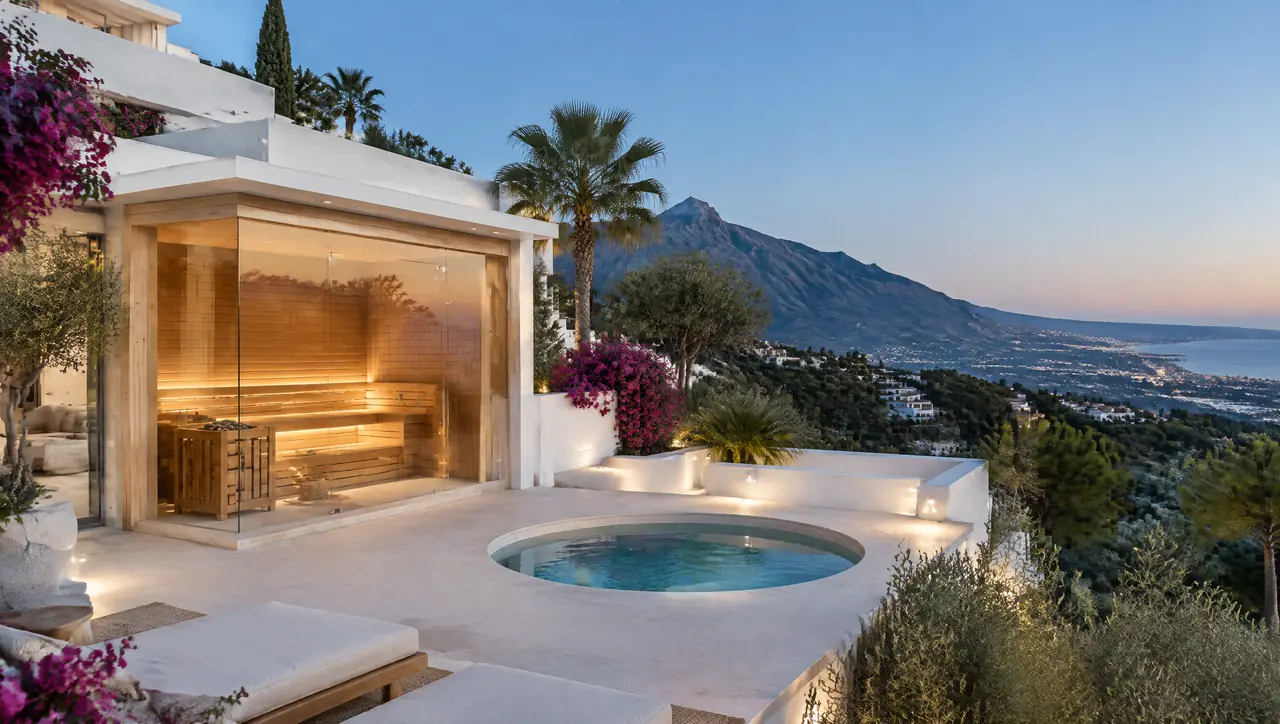
Marbella and the Costa del Sol
Villas, estates, hotels and padel clubs: a pool that stays cold when the terral blows.
Read on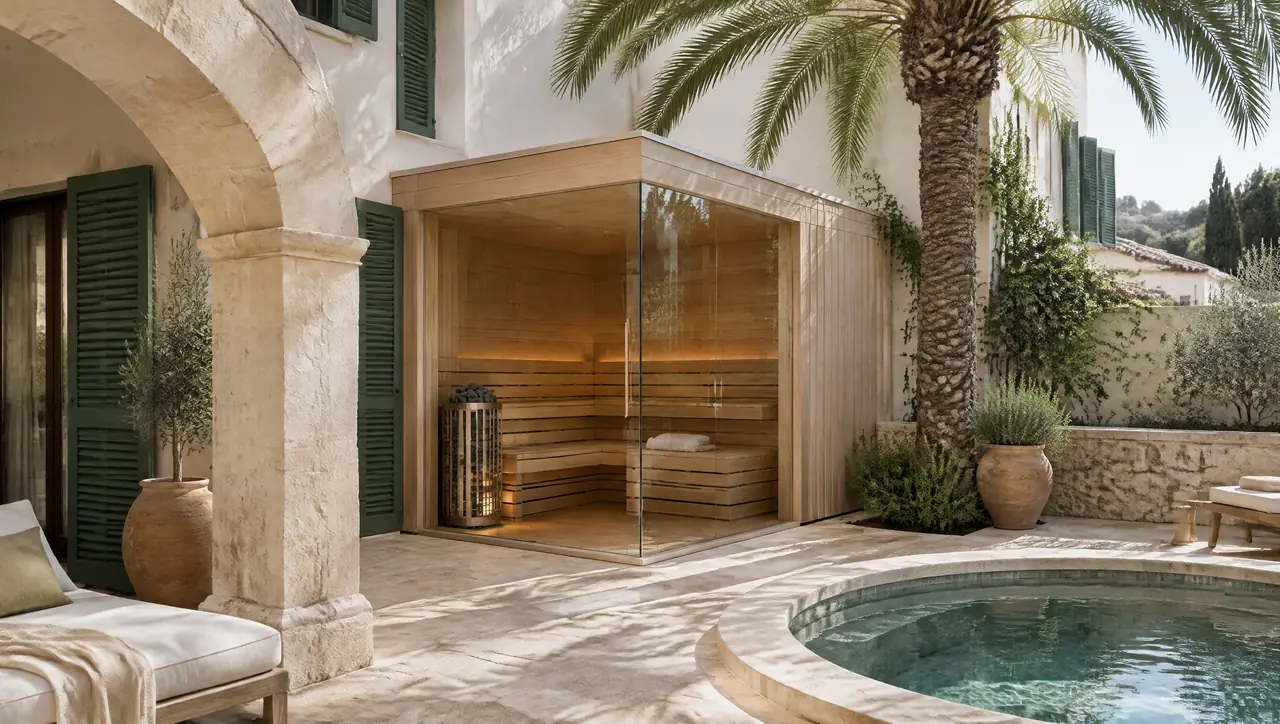
Mallorca
Fincas, Palma patios and hotels: stone, olive terraces, island freight and a plant that respects the water.
Read on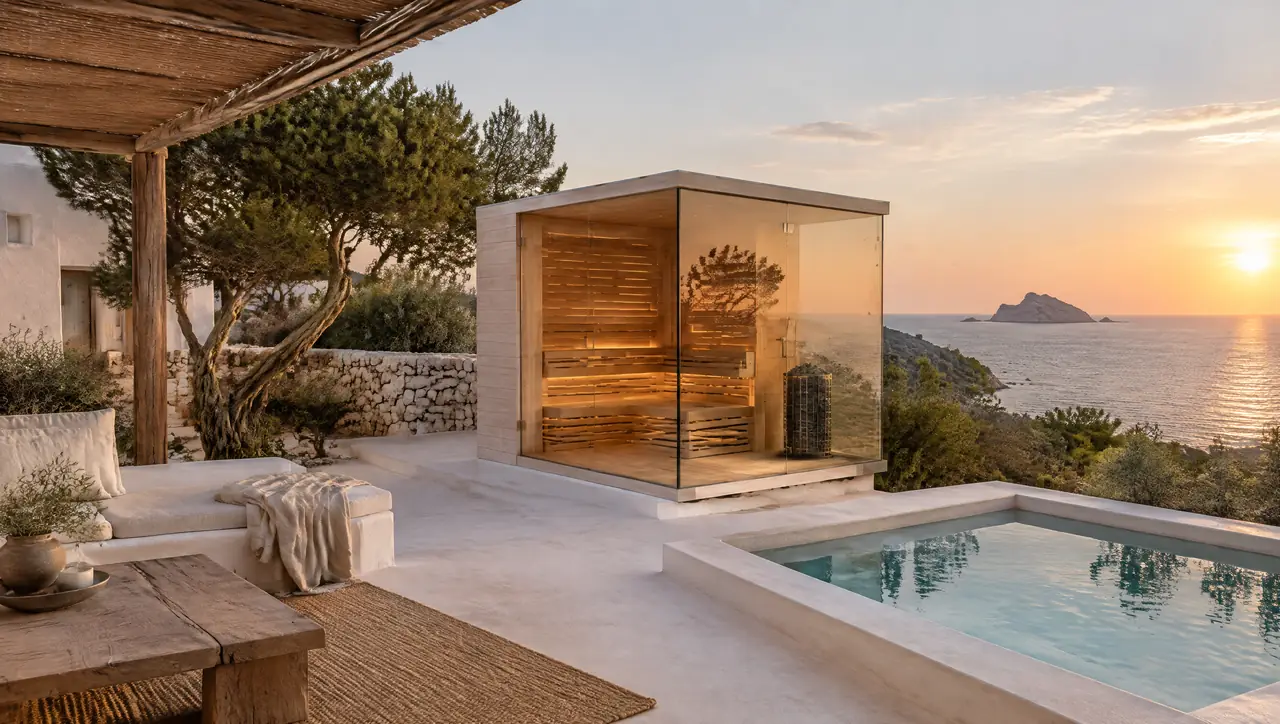
Ibiza and Menorca
Cubic villas, agroturismos and boutique hotels: islands that love a plunge pool and regulate what you build.
Read on