Collection · 08 · Chillers and plant
Chillers and plant for plunge pools: sized by the litre, built for 40 °C air
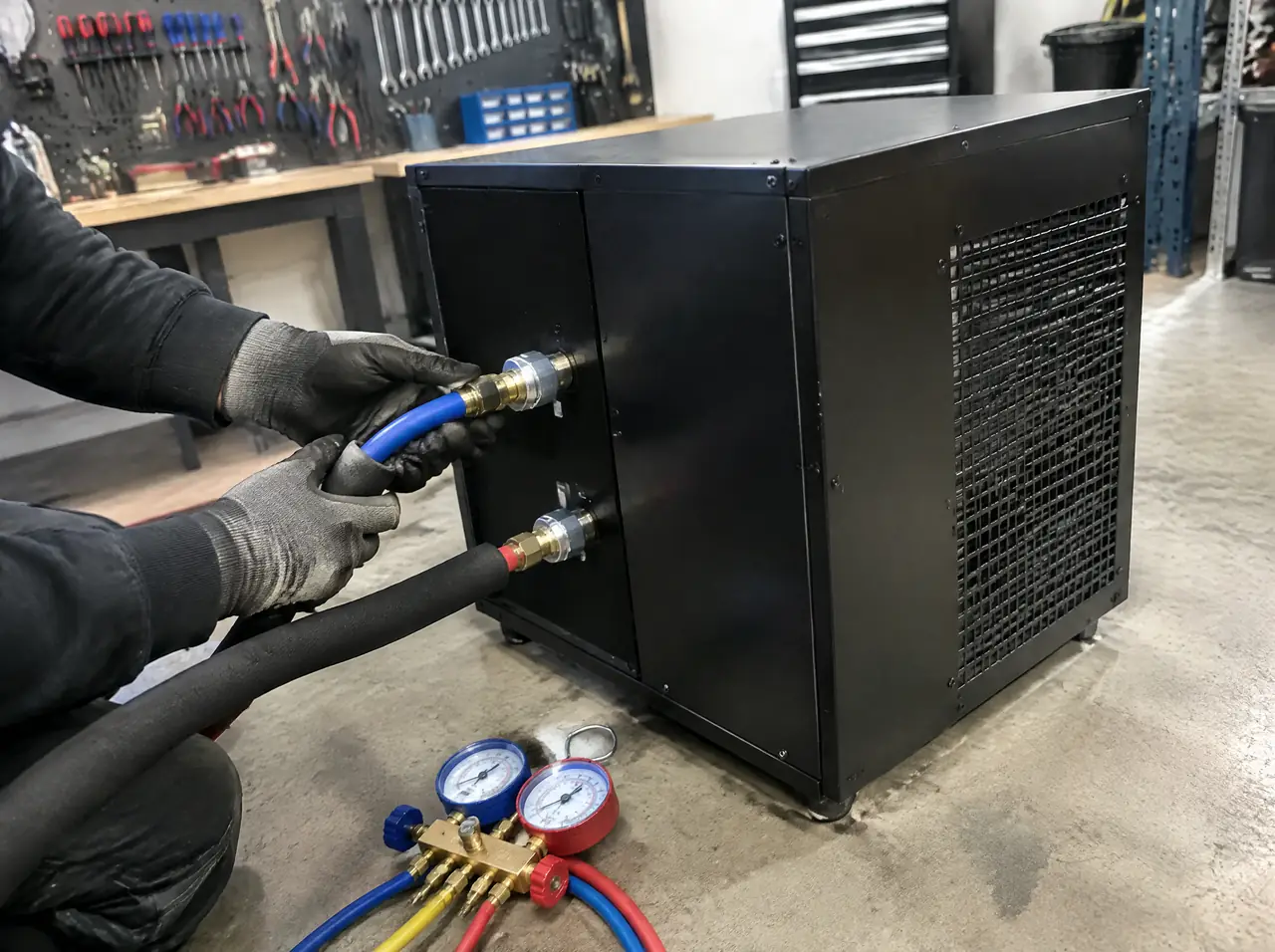
The chiller is the part you do not see and the part that decides whether the pool is cold in August. We build ours on our own line, size them by the litres in the basin and the heat of the place, and draw where they stand so they can breathe.
Sections on this page
Three classes, by litres
We size by the water you want to hold at 3–5 °C. The classes are simple, and the table is the one we work from. The amps are what the unit draws, at 230 V single phase:
| Class | Water held | Draw (approx.) | Amps at 230 V | Indicative range |
|---|---|---|---|---|
| 1 HP | up to 260 L | 0.9 kW | about 4 A | €2,600–3,500 |
| 2 HP | up to 570 L | 1.8 kW | about 8 A | €3,500–5,300 |
| 4 HP | up to 1,200 L | 3.6 kW | about 16 A | €5,700–8,400 |
Above 1,200 litres we use two 4 HP units rather than a bigger one, which also gives you a unit to fall back on when one is serviced. A pair of pools shares a plant room, not a chiller: the warm pool is heated, the cold pool is chilled, and each is sized on its own.
A chiller in a closed cupboard is a heater
A chiller does not make cold, it moves heat. Whatever it takes out of the pool it throws into the air around it, and if that air cannot leave, the machine breathes its own exhaust and the pool stops getting cold. On a terrace in Seville or Limassol the air is already 38–40 °C; add a walled niche and a south-facing wall and you have built an oven. So we draw the machine's air first: where it comes in, where it goes out, and how far apart those two are.
Niche, plant room or buried chamber
- A ventilated niche in a wall or under a bench: cheapest, closest to the pool, and fine in shade with a louvred door. Not suitable in a closed courtyard.
- A plant room: a small room with its own air path, drains and light. Right for hotels and clubs, and the only sensible home for a pair of pools or two chillers.
- A buried chamber with an inspection lid: invisible, but a chiller rejects several kilowatts of heat, so the chamber needs a ducted air path in and out as well as drainage; we do not bury a chiller in a hole that floods or cannot breathe.
Electrics and the question of phases
A 4 HP unit draws about 3.6 kW, which is about 16 A on a 230 V single phase: comfortable on a villa board with a dedicated circuit, awkward when the board is already full of heating and cooking. A commercial site may be offered three-phase, which spreads the load. Ask your electrician for a dedicated, protected circuit to the plant space and tell us what he says. Villa mains or three-phase explains the difference.
Noise, neighbours and the bedroom window
Compressors hum. A chiller one metre from a bedroom window will be heard at night, however well it is built. We position it away from sleeping rooms and neighbours, and we put the sound data in the quote when the unit is chosen, not afterwards.
The three numbers we ask for
- Litres. The volume of the basin or tub, including steps, with a margin for the pipework.
- The hottest afternoon. The air temperature the machine must work in, which in the Mediterranean we take as 38–40 °C, and the shade it will have.
- How hard it is used. A household that plunges twice a day is a light load. A hotel pool with a bather every few minutes is warmed by every body that enters it, by the sun and by every top-up from the mains, and is designed for the long duty, up to 16 hours a day, that our chillers are built for.
Service, warranty and a coil that sees salt
Everything we build carries a two-year warranty, with assisted service visits during the first year. In practice the maintenance is small: keep the air path clear, rinse the condenser coil once or twice a year, and near the sea ask for it to be checked for salt build-up. Salt air, timber, glass and steel lists the rest.
Chillers are listed on their own in the price list, and the kit builder chooses the class for you from the litres of the pool or tub.
Can one chiller serve a pool and a tub?
Only if their combined litres fit the class, and only if both are used rarely at the same time. In practice each gets its own, so one can be serviced while the other works.
Do you build the chiller yourselves?
Yes. We have our own chiller line and our own joinery, which is why the unit, the pool or tub and the controls are drawn as one system.
Why do chillers lose strength in hot weather?
Because the cooler the air they reject heat into, the easier the job. At 40 °C the same machine has less margin than at 20 °C, which is why we size for the heat of the place and say so in the quote.
Alongside
What one chiller is asked to hold cold
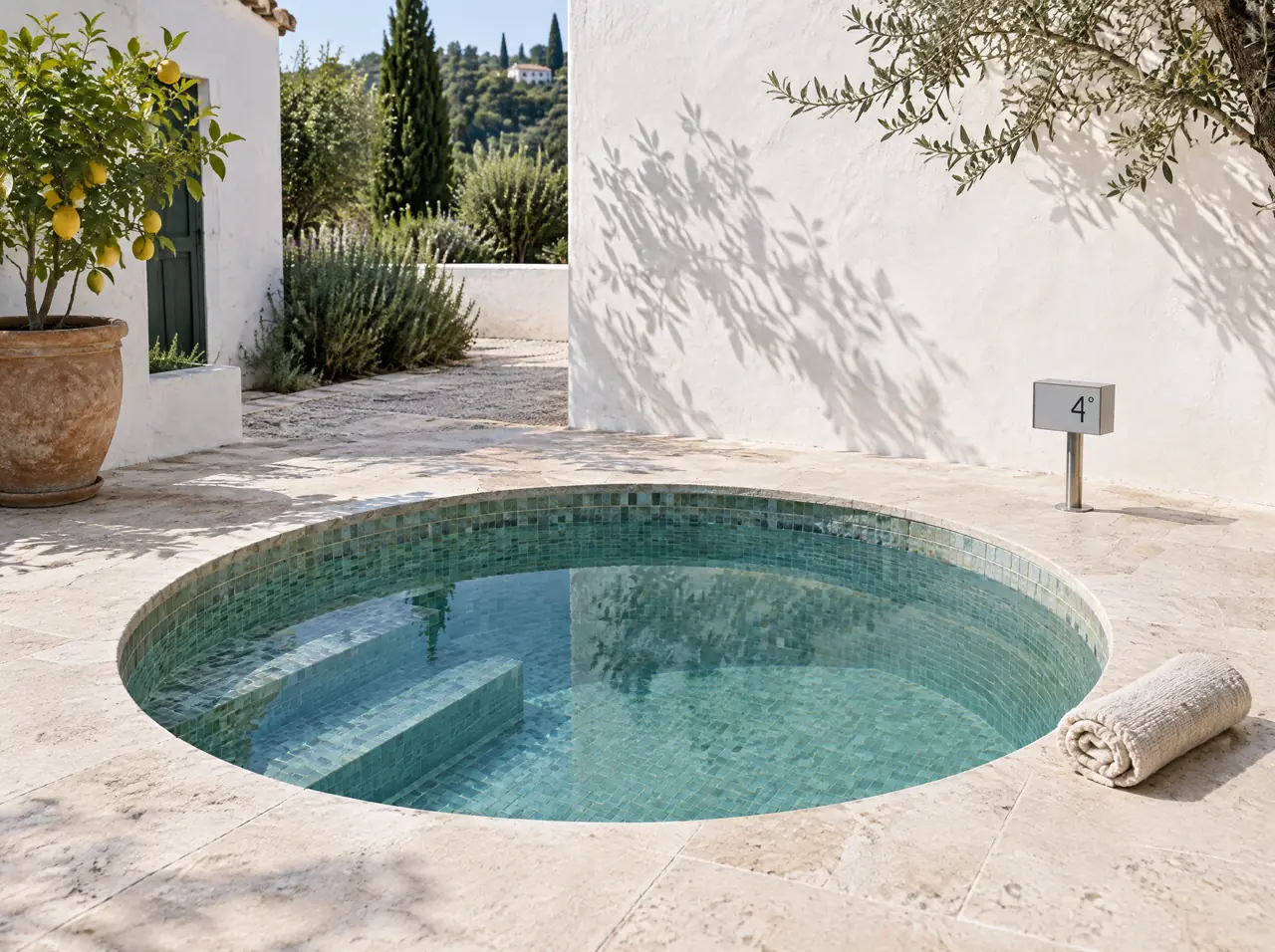
Cold plunge pools built into the terrace
Round or square, glass mosaic or tile, flush with the floor and held at 3–5 °C. The machinery stays out of sight.
Read on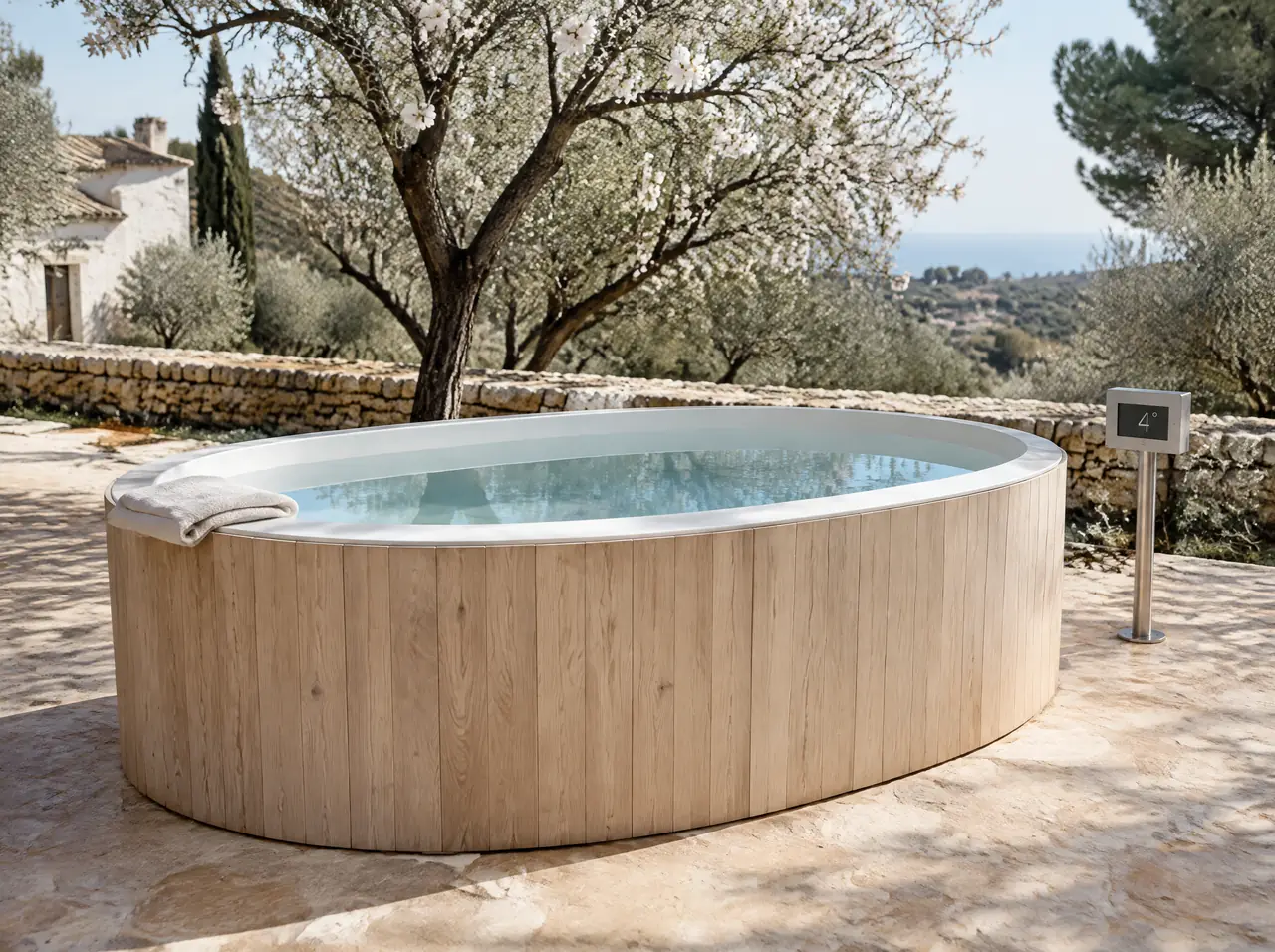
Wooden plunge tubs with a white liner
Oval or round tubs in ash or cedar with a white liner, 250 to 1,000 litres, for private homes.
Read on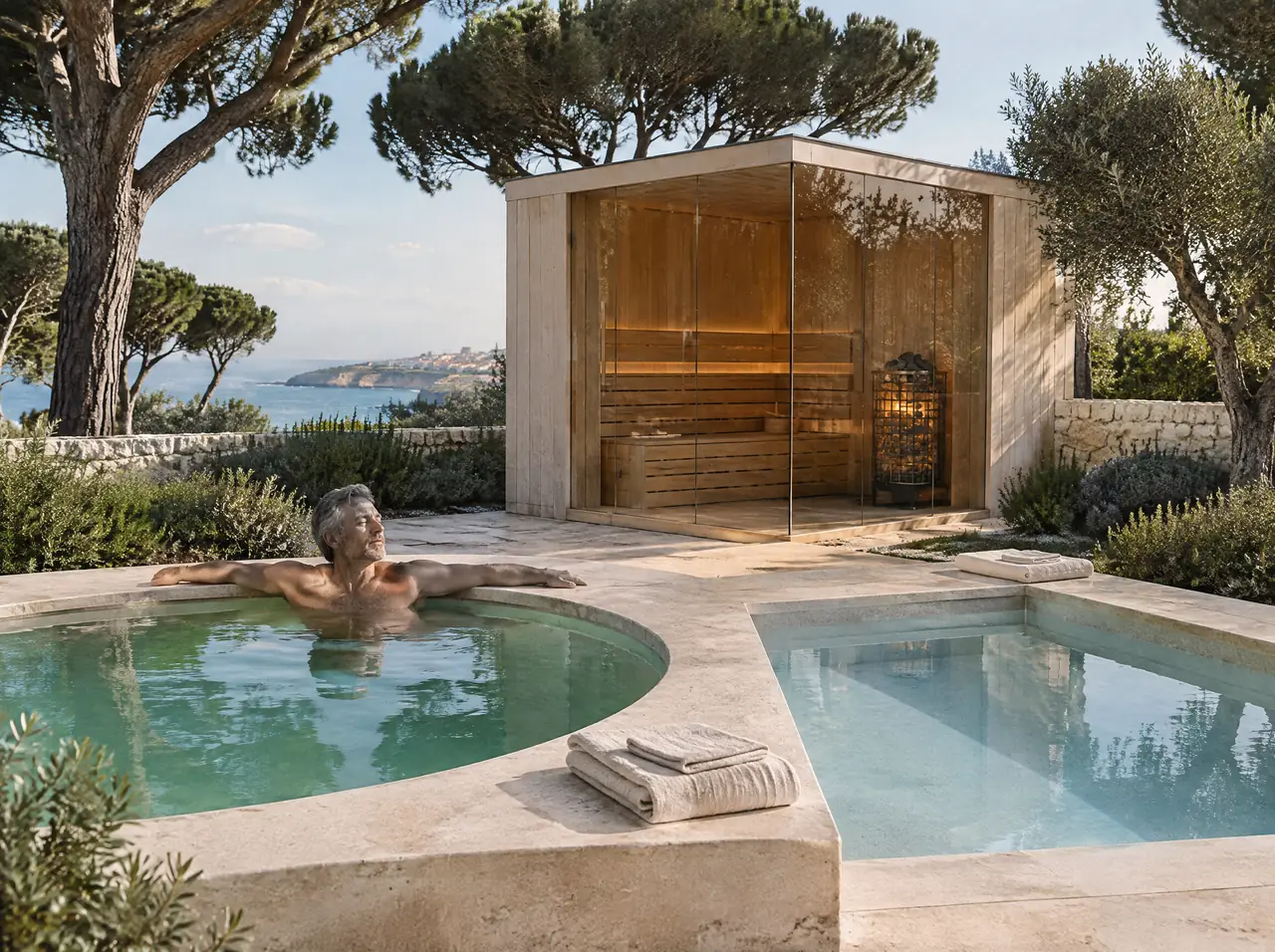
Warm pool, cold pool, one plant room
A 38 °C pool and a 4 °C pool side by side, with a sauna or without. One plant room, one drawing.
Read on