Note · Energy
A wall of glass and its electricity bill: the sums behind a glass sauna
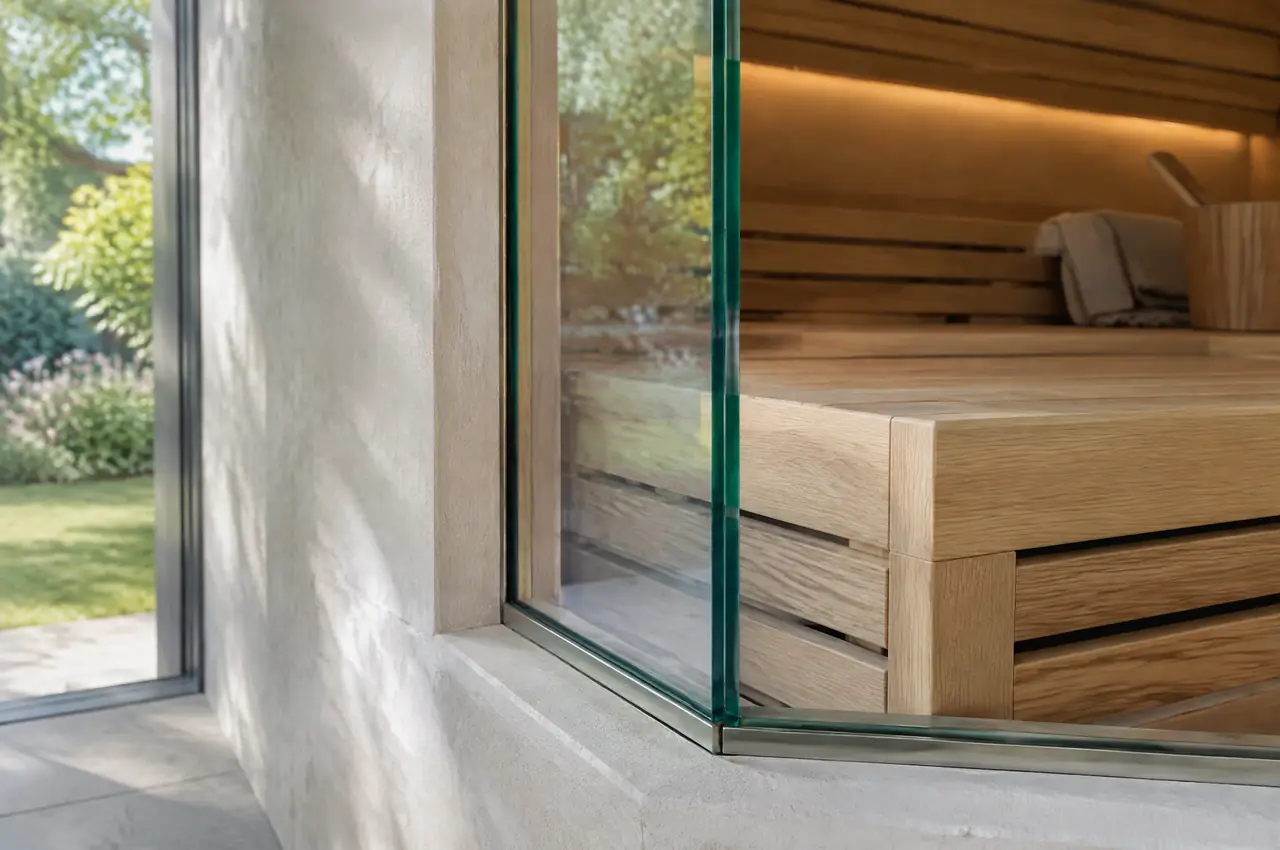
Glass is the most beautiful wall in a sauna and the leakiest. This note puts numbers on both: what a square metre of glass loses, why the heater moves up a step, what a session costs at your tariff and where the heat escapes when it should not.
Sections on this page
Short version: a 90 °C cabin loses about 14 times more heat through a square metre of single toughened glass than through a square metre of insulated timber wall. That is not a reason to give up glass. It is a reason to size the heater for it, to put the glass where it earns its place and to look after the seals.
What a square metre of glass loses
Heat loss through a surface is its U-value, in watts per square metre per kelvin, multiplied by the temperature difference. Single toughened glass has a U-value of roughly 5.7. A well-insulated sauna wall, with a vapour barrier and mineral wool behind the boards, is closer to 0.4. At 90 °C inside and 20 °C outside, the difference is 70 K:
| Surface | U-value (W/m²K) | Loss per m² at 70 K | Two m² |
|---|---|---|---|
| Insulated timber wall | about 0.4 | about 28 W | about 56 W |
| Single toughened glass | about 5.7 | about 400 W | about 800 W |
Two square metres of glass therefore cost about 800 W, which a heater must make up before it can warm the cabin. These are rule-of-thumb figures; a design calculation in your quote replaces them with the numbers for your cabin.
Why the heater steps up
Heater makers rate each heater for a range of cabin volumes and ask you to add volume for glass and for any other surface that is not insulated. Glass loses far more than a wall, so a glass cabin needs a heater from a higher rating than an opaque cabin of the same size. The ratings in our table are the ones we fit to each plan, and the 3D layout shows the working for your cabin. The result is a heater that reaches 90 °C in about forty minutes and holds it, rather than one that chases the temperature all session.
What a session costs to run
Take a cabin with a 6 kW heater. Heating from cold takes about forty minutes at full power: 4 kWh. An hour of use then draws about half that rating on average: 3 kWh. Call it 7 kWh for a session block. At an illustrative €0.25 per kWh that is €1.75; at €0.35 it is €2.45. Use your own tariff: the sums are simple. The chiller for a plunge pool is a separate line: a 4 HP unit draws about 3.6 kW while it runs, and it cycles.
Tariffs differ by country, and Eurostat publishes household electricity prices every half-year. For a household using 2,500 to 4,999 kWh a year, with all taxes and levies included, the latest figures it holds are below, with the cost of the seven-kilowatt-hour session block above at each price.
| Country | Price per kWh | Period | A seven-kWh session block |
|---|---|---|---|
| Spain | €0.2509 | first half of 2026 | €1.76 |
| Portugal | €0.2367 | first half of 2026 | €1.66 |
| Cyprus | €0.2688 | first half of 2026 | €1.88 |
| Ireland | €0.4042 | second half of 2025 | €2.83 |
| Italy | €0.2966 | second half of 2025 | €2.08 |
| Greece | €0.2401 | first half of 2026 | €1.68 |
| Croatia | €0.1816 | first half of 2026 | €1.27 |
| EU average | €0.2896 | second half of 2025 | €2.03 |
Source: Eurostat, dataset nrg_pc_204, consumption band 2,500 to 4,999 kWh, all taxes included, read in October 2026. Ireland's figure rose from €0.3231 to €0.4042 between the first and second halves of 2025, and the series includes government allowances, so use the price on your own bill. A business pays on a different tariff.
Where heat escapes when it should not
- Door seals and the threshold. A worn seal lets the hottest air leave at head height, and the heater compensates.
- The vent left open. Ventilation is needed, but a vent that is wide open to a draughty room costs real power.
- Heating an empty cabin. Forty minutes is the heat-up time; turning the heater on at noon for a session at six is a habit worth breaking. A timer on the heater is the cheapest fix.
- Glass where nobody looks. A glass wall that faces a blank hedge costs the heat and gives nothing back. Put the glass where the view is, and the solid wall where it is not.
The arithmetic of a timer
Preheating is the habit that costs most. A 6 kW heater that is switched on at noon for a session at six runs its element for forty minutes at full power and then cycles to hold 90 °C for five more hours. At about half power on average that is another 15 kWh for a session that uses seven. A timer that switches the heater on forty minutes before the session turns 22 kWh into 7 kWh. At €0.25 per kWh the difference is about €3.75 a session, or more than €1,300 a year for a cabin used every day.
A glass cabin in winter and in summer
Outdoors in winter the difference between 90 °C inside and 5 °C outside is 85 K, and the glass loses more than in our 70 K example. In a Mediterranean summer the outside is 30 °C and the glass loses less, but sun on the glass adds heat before the heater does. A cabin that works in both seasons has a heater sized for the winter and glass that is shaded or turned in summer.
Which way the glass faces
Glass on the sunny side of a cabin collects heat on a summer afternoon before the heater has done anything, which suits a winter session and troubles a summer one. Glass on the windward side loses more than the table above says, because wind strips warmth from the outer surface. On the Atlantic coast we turn the glass away from the south-west and give it a roof edge; on the Mediterranean we shade the west-facing pane and let the evening light in through the one that faces the garden.
The walls, roof and floor that are not glass
The glass gets the attention, but the rest of the shell does most of the work. Heat rises, so the ceiling is the hottest surface in the room and the roof insulation matters more than the walls'. The floor of an outdoor cabin sits over a ventilated base, and an uninsulated floor loses heat to the cold air passing beneath it. A continuous vapour barrier on the hot side keeps damp out of the insulation. These details cost little to build and a great deal to put right afterwards.
What to ask a maker
- The heater rating, and the volume and glass area it was sized for.
- The U-value or the construction of the walls, roof and floor, and where the insulation sits.
- The seal on the door and the fixed glass, and what it is made of.
- The load in kW and amps, and whether the circuit can take it.
- Whether the controller has a timer and an over-temperature cut-out.
These are the questions we answer in the layout for every glass-front sauna. For what the whole project costs, see what an outdoor sauna costs.
Glass shapes the drawing most where the weather is wettest or the sun hardest: see garden saunas for the base and the roof, and Ireland and the Algarve for the two climates.
Does a bigger heater use more power?
It draws more while it heats, but it heats the cabin sooner and then cycles. A heater that is too small runs at full power for the whole session and uses as much or more.
Is double glazing used in saunas?
Some outdoor cabins use a second pane or a coating on the outer face. Whether it is rated for the temperature is a question for the glass supplier, and we state what we use in the quote.
What does a timber sauna lose compared with glass?
Much less per square metre, which is why we keep the glass to the walls that frame a view.
Further notes
Notes that continue this one
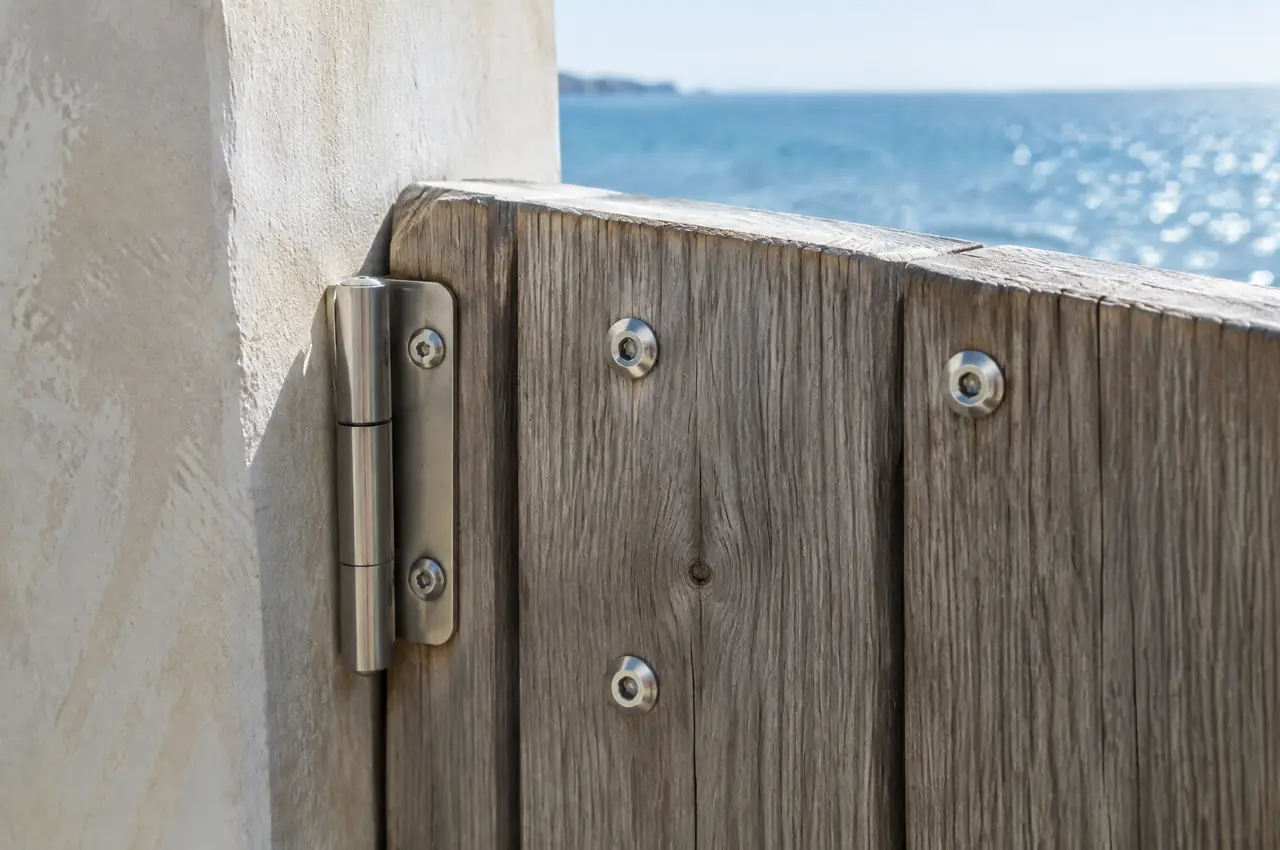
Salt air on timber, glass and steel
Where salt travels, why 316 steel, how timber ages and a yearly checklist for coastal saunas.
Read on
Outdoor sauna cost in euros, line by line
Ranges in euros by size, the nine lines of a quote and what changes by country.
Read on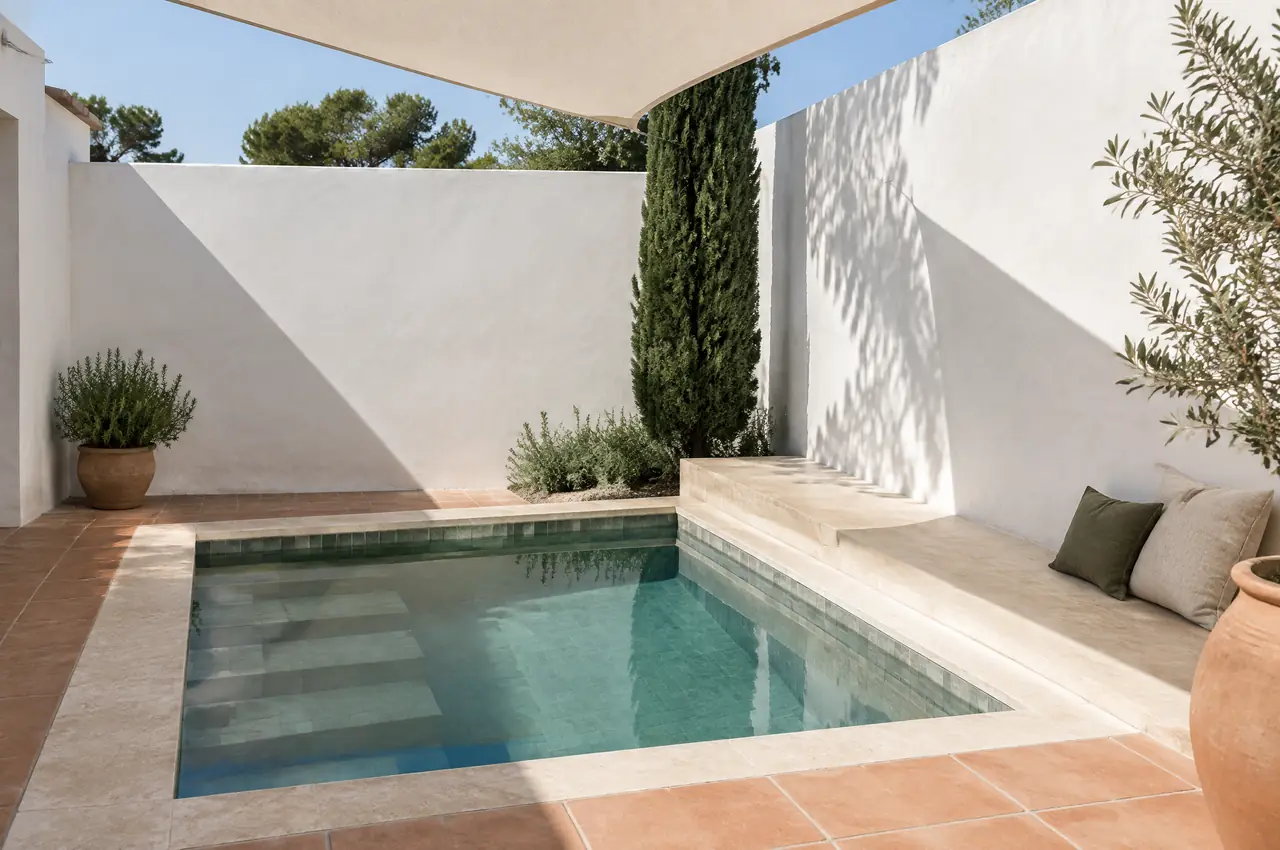
Cold plunge pools in a Mediterranean summer
Four sources of heat, three chiller classes and the shade and cover that matter more than a bigger machine.
Read on