Note · Hygiene
Hygiene for a commercial plunge pool: filtration, disinfection and a rota that holds
A pool used by strangers is a hygiene system with a cooling system attached. This note describes the layers, what UV, ozone and chlorine each do and do not do, the numbers you must take from your own national rules, and the log sheet that proves it.
Sections on this page
Short version: cold water slows microbes, it does not stop them. A commercial plunge pool needs a rinse before entry, filtration sized to the bather load, disinfection that leaves a measurable result, a plan for water changes and a log that someone signs. We are not a water-treatment authority: the numbers you must meet come from your country's rules and your health authority.
Four layers, in order
- Before the water: a shower or rinse for every bather, a notice, and a floor that stays clean.
- Filtration: a filter sized to the bather load, run long enough each day, backwashed or changed on a schedule.
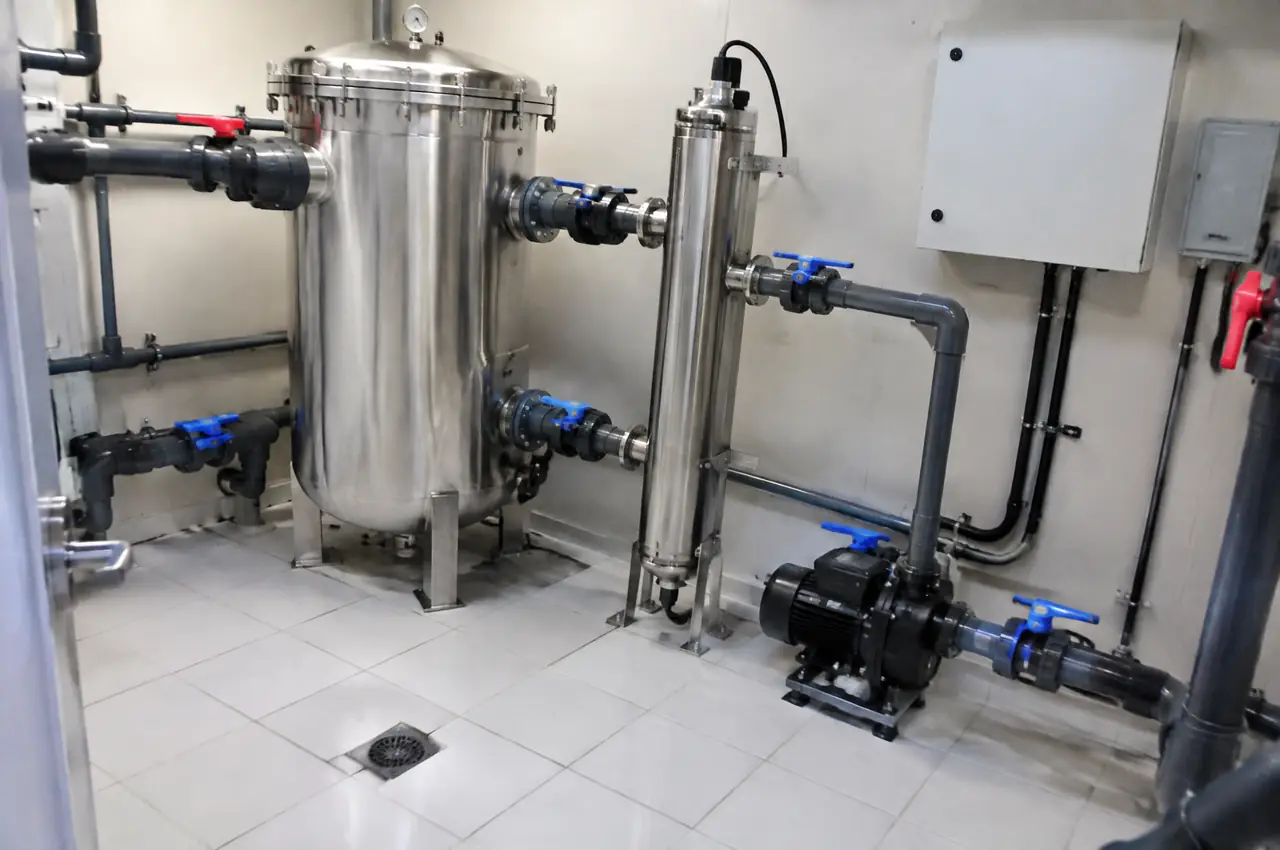
- Disinfection: UV, a chlorine residual, ozone, or a combination, chosen for the use.
- Replacement: a partial change of water on a rota, and a full drain at intervals your authority or your supplier sets.
UV, chlorine and ozone: what each does
| What it does | What it leaves | What to watch | |
|---|---|---|---|
| UV | inactivates microbes as the water passes the lamp | no residual in the pool | lamp life, a clean quartz sleeve, flow rate |
| Chlorine | oxidises and kills; keeps working in the pool | a measurable residual | pH, the smell, a reading by test |
| Ozone | a strong oxidiser, effective on organic matter | no residual; needs treatment before water returns | off-gassing, extraction, maintenance |
| A combination | UV or ozone for strength, a low chlorine residual for the pool | a small residual | more to look after; a clear routine |
A common plant for a small hotel pool is filtration plus UV plus a low chlorine residual. The right answer depends on the use, the staff and the rules that apply to you.
The numbers come from your national rules: one example
Spain's Real Decreto 742/2013 sets, in Annex I, the values for pools of public use: pH between 7.2 and 8.0, free residual chlorine between 0.5 and 2.0 mg/L, combined chlorine no more than 0.6 mg/L and turbidity no more than 5 UNF, with the pool to be closed if turbidity passes 20 or free chlorine is absent or above 5. The temperature range in the annex, 24 to 30 °C, is for heated vessels. The decree does not name plunge pools, so whether yours falls under it is a question for your regional health authority.
Other countries have their own texts and their own numbers. For a hotel, club or clinic, take them from the authority that inspects you, put them in the plant schedule and write them on the log sheet. Standards that help: EN 15288-1:2018+A1:2024 for the safety of pool design and EN 15288-2:2018 for operation, both for pools for public use.
Opening a seasonal pool
A hotel pool that closes for part of the year is opened by a routine, not an event. Clean the basin and the coping, check the covers, restart the pumps and run the filtration until the water is clear, then test the disinfectant and the pH and write the first readings on the log before the first bather. Closing is the same sheet in reverse, with the filter cleaned and the chiller's coil rinsed. If the pool stays full through the winter, someone still looks at it every week.
Bather load and the rota
A pool used by thirty guests a day is not a pool used by three. Filtration and disinfection are sized to the load, the rota is set by it and the water change follows. Ask for the bather load in the brief, and we size the plant to it. A pool that is quiet in March and full in August needs a routine that scales.
The log sheet
The log hangs on the plant room door. It is the document an inspector can ask to see, and the one that settles an argument.
Why cold water is not self-cleaning
Cold water slows the growth of microbes, and it slows the action of disinfectants too. Chlorine and ozone work more slowly at 4 °C than at 28 °C, so a plunge pool needs a considered disinfection plan, not a smaller one. Add the organic load of sweat, sunscreen and skin, a pool a few people share, and a surface that is often covered and in the dark overnight: there is every reason to clean it properly.
What each reading tells you
| Reading | Why it matters | What staff do about it |
|---|---|---|
| Disinfectant level | shows whether the water can deal with what bathers bring | test it daily; correct it by the plant's instructions |
| pH | affects how well a disinfectant works and how the water feels | test it daily; correct it, or call the technician |
| Clarity or turbidity | the first sign that filtration is behind the load | look every morning; backwash or clean the filter |
| Temperature | tells you the chiller is holding | read the display, compare it with a separate thermometer |
A weekly test routine, in order
- Take a sample at elbow depth, away from the inlet.
- Test the disinfectant and the pH with a kit or a meter, and write the numbers on the log.
- Check the filter pressure gauge against last week.
- Look at the UV lamp indicator and the sleeve.
- Clean the steps, coping and the waterline.
- Initial the log; if a number is out, note what you did.
What goes wrong
- A pool left uncovered at night, with leaves, insects and dust in the morning.
- A UV lamp past its life, still glowing, no longer working.
- A filter run for too short a time because the pump is noisy.
- No rota for the water change, so nobody does it.
The pools in question are described on plunge pools and the plant on chiller systems; Spain is the country whose pool decree is quoted above.
Do I need chlorine in a cold pool?
That depends on your rules and the use. Many commercial pools use a low chlorine residual with UV. Ask your health authority.
How often do I change the water?
On the rota we write with you, which follows the bather load, the filtration and the rules that apply.
Is a plunge pool covered by pool regulations?
It can be, when used by the public or by guests. See permits compared and ask your health authority.
Further notes
Notes that continue this one
Single-phase or three-phase at the villa
Amps for a heater and a chiller, when single-phase is enough and what to ask your electrician.
Read on
Cold plunge pools in a Mediterranean summer
Four sources of heat, three chiller classes and the shade and cover that matter more than a bigger machine.
Read on
Recovery rooms members actually use
Size by the match, run it by a rota, draw the floor for wet feet and leave out what you will not clean.
Read on