Ireland · IE
Ireland, where sauna and cold dip is a habit before it is a product
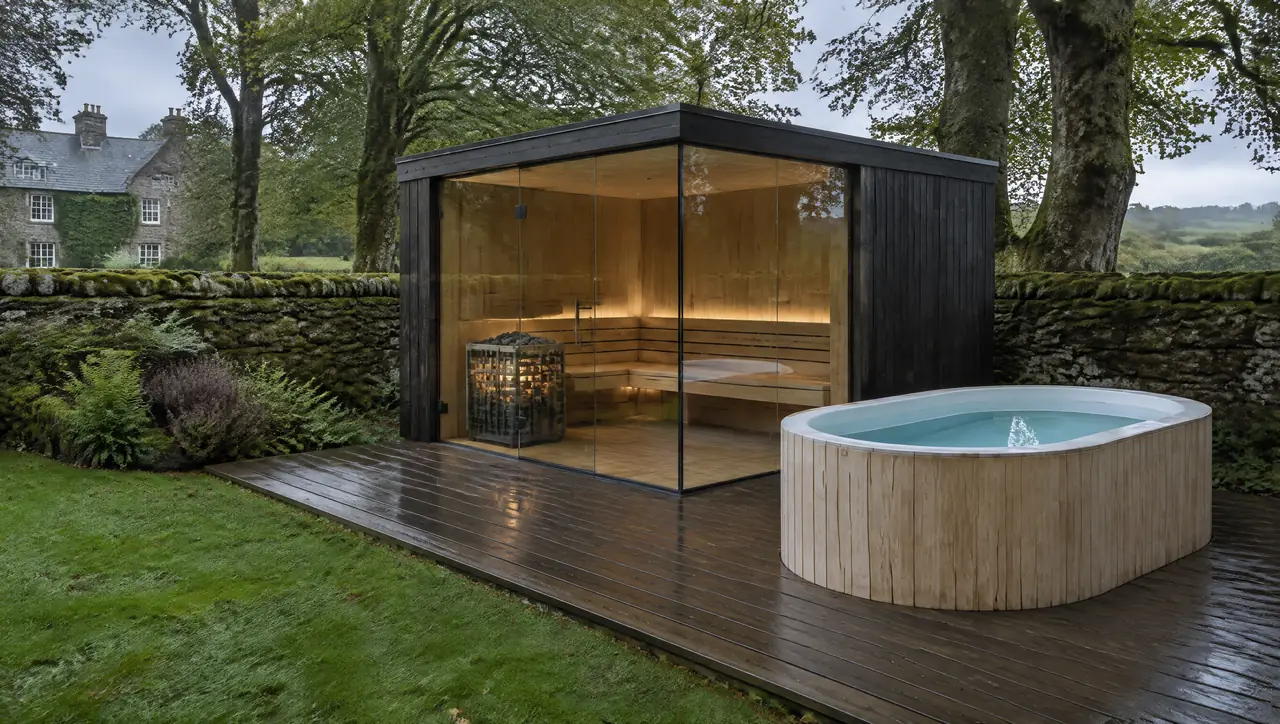
The Irish were sea swimming long before anyone sold a cold plunge. What a household needs is a weatherproof deck, a cabin that survives a storm and somewhere to warm up afterwards: the sauna and the cold dip, side by side, with a robe hook between them.
Sections on this page
- Built for rain, wind and salt
- Who this is for, and what each needs
- Planning in Ireland: the questions, in order
- Mains and the long cable run
- A deck that works in November
- Three places, three briefs
- A coastal house and a hotel, in numbers
- The Irish calendar: sauna and cold dip
- Five ways an Irish project fails in its first winter
Built for rain, wind and salt
| The Irish weather | What it does | What we draw |
|---|---|---|
| Rain, nearly every week | soaks timber, floods bases, finds every seal | membrane roof with falls, ventilated cladding, a drained and raised base |
| Wind from the south-west | lifts roofs, drives rain into doors, rattles glass | glass turned away from the wind, a deep drip edge, fixings that are 316 stainless |
| Salt on the coast | browns steel, dulls glass, eats aluminium fins | marine-grade fixings, rinseable surfaces, a protected chiller coil |
| Mild winters, cool summers | water that is already cold | a chiller that holds 4 °C in July and a warm pool or cabin for the other months |
What the averages say: Met Éireann's 1991–2020 figures run from 772.5 mm of rain a year at Dublin Airport to 1,646.5 mm at Valentia Observatory, with July mean daily maxima of 17.8 to 19.5 °C and January minima of 2.3 to 5.1 °C. Cool summers, mild winters and a great deal of rain: the design condition is wet, not hot.
Who this is for, and what each needs
- Sea swimmers and their households: a cabin for six on the deck above the slipway, a plunge pool within five steps and a place for wet robes. See from sea swimming to sauna and cold dip.
- Country houses and lodges: walled gardens, hotels with grounds, a glass cabin among beech trees.
- Hotels, gyms and clinics in the cities: recovery rooms and courtyard cabins; see commercial.
- Developers and architects: amenity decks in apartment schemes, run by an owners' management company.
Planning in Ireland: the questions, in order
Irish exemptions are among the clearest we found. A shed, store, greenhouse or similar structure in the curtilage of a house is exempt from planning permission up to 30 m² in total, behind the front wall, no higher than 4 m with a pitched slated roof or 3 m otherwise, and leaving 25 m² of private open space to the rear or side (S.I. 338 of 2026, in operation from 27 July 2026). Whether a glass sauna cabin counts is for your local authority to say, a pool is not named, and a protected structure changes the answer: see permits compared.
Mains and the long cable run
ESB Networks' Distribution Code (version 8.0, February 2023) sets the low-voltage tolerance at 230 V ±10%, 207 to 253 V, at a nominal 50 Hz. A standard domestic connection is listed as 12 kVA, a maximum demand of 52 A, and an enhanced one as 16 kVA, 70 A. ESB's own page says a three-phase supply may be required for larger motors or for several loads at once, and does not describe a dedicated domestic three-phase offer.
Our loads against those numbers: a 6 kW heater draws about 26 A and a 4 HP chiller about 16 A, together 42 A, which leaves little of 52 A for an oven and a shower. The heater on a timer and the chiller on its own circuit are the usual answer, and a long cable run is sized for the distance.
A deck that works in November
- Gapped boards on adjustable supports, with a stainless drainage channel at the foot of the cabin.
- A roof that sheds: membrane, falls, a deep overhang and a drip edge.
- Robe hooks and a boot tray under cover: the details that decide whether it is used in a gale.
- Low lighting, because in winter you arrive in the dark and leave in it.
- A cover for the pool that one person can lift in the wind.
Three places, three briefs
Dublin and Wicklow: Victorian gardens, long and narrow, beside the bay. Cork and Kerry: headlands, lodges and one-lane roads. Galway and the west: bog, limestone and the most exposed plots we draw.
A coastal house and a hotel, in numbers
The Irish calendar: sauna and cold dip
In Ireland the cold half of the pair is the sea and the cabin is the answer for the rest. Winter is the season for the sauna, from October to March. Spring brings longer evenings and the first lighter swims. Summer is cool, and the plunge pool keeps its 4 °C when the sea is warmer and the day is bright. Autumn is the second winter and the season of storms. A deck that works in all four is the product.
Five ways an Irish project fails in its first winter
- A cabin without a drained and ventilated base.
- A door that faces the weather, and a seal that nobody checks.
- A deck that holds water, because the boards have no gaps and the foot of the cabin no channel.
- A long cable run sized to the minimum.
- An order placed before the planning question has been asked.
Both lines above come from the price list; the kit builder shows the weatherproof deck as an extra.
Do I need planning permission for a garden sauna?
It depends on the structure, the plot and the council. Our note on permits compared sets out what we could verify and what to ask your local authority.
Can a sauna survive an Irish winter outdoors?
Yes, with a membrane roof, ventilated cladding and a base that drains. It is how we build them.
Do you offer ice baths in Ireland?
Yes: free-standing ice baths with a chiller for private homes, and plunge pools for hotels and clubs.
Do you have an office in Ireland?
No. Plans are drawn in 3D, the work is built in our own workshop and the crates are shipped to Ireland. The quote includes installation, and we say plainly who carries it out at your address before a deposit.
Other coasts
The same drawing under a different sky
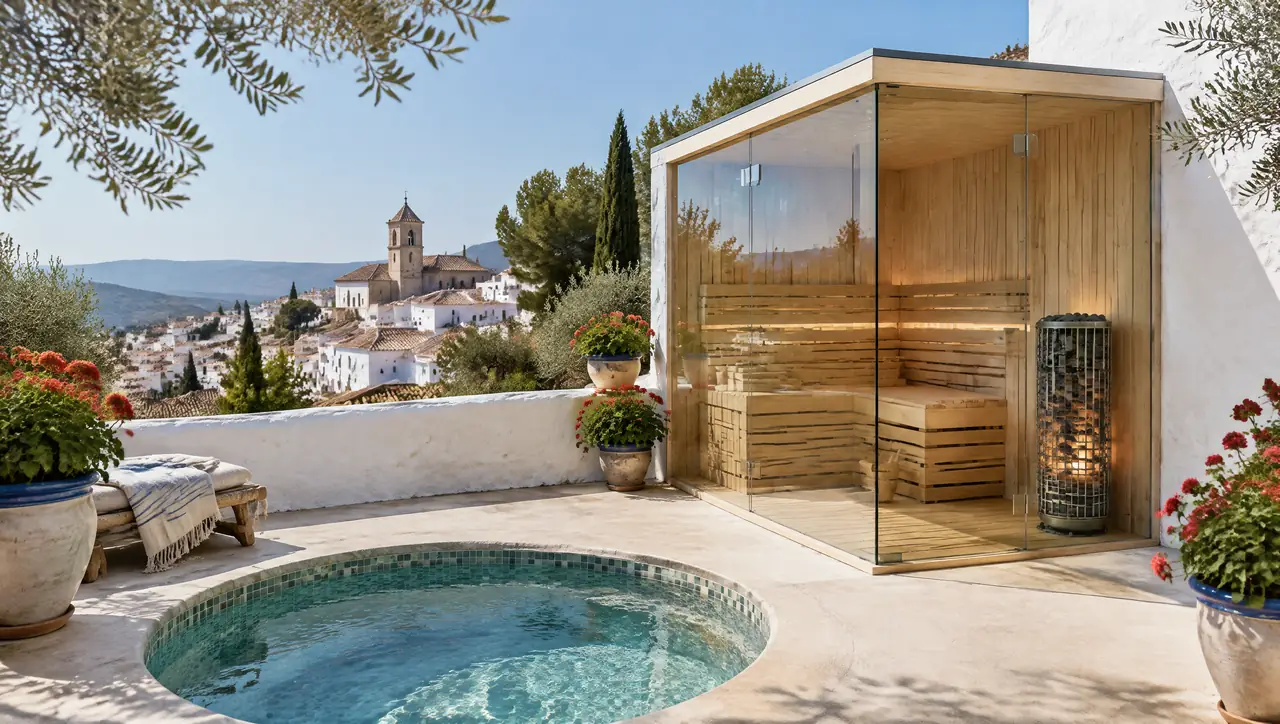
Spain
Villas, fincas, hotels and clubs from the Costa del Sol to the islands: heat, rules, power and ranges.
Read on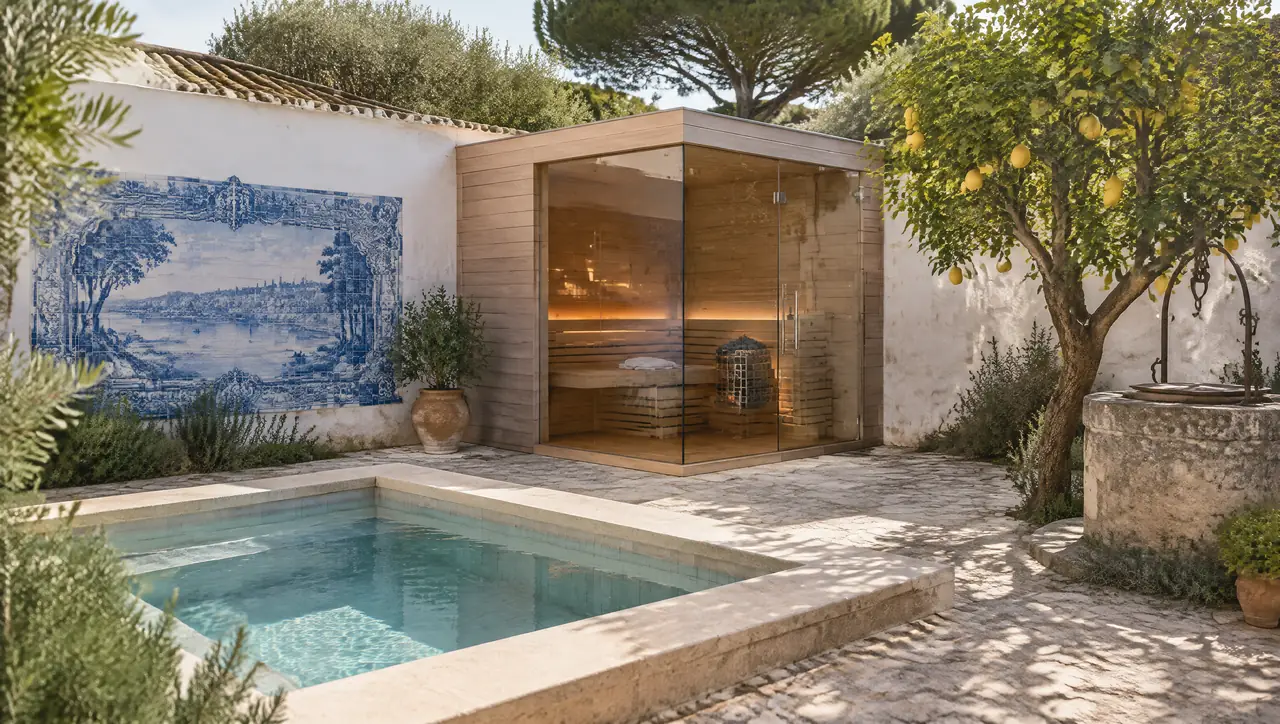
Portugal
Algarve, Lisbon, Comporta, Porto and Madeira: Atlantic wind, alojamento local and municipal rules.
Read on
Cyprus
Limassol towers, Paphos villas and Troodos villages: heat, humidity and water scarcity shape every project.
Read on