Collection · 09 · Hydromassage hot tubs
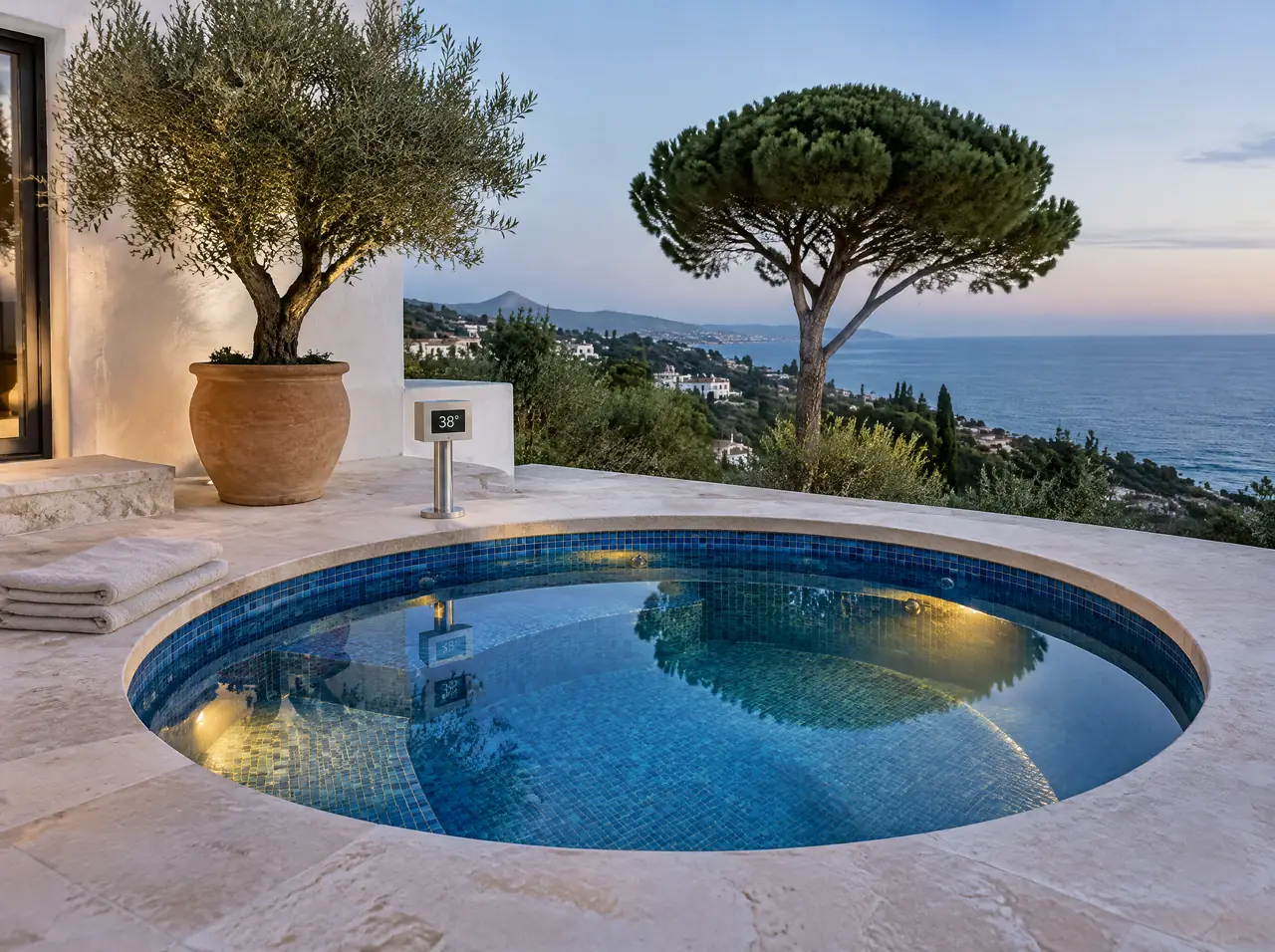
A hot tub laid in mosaic, held at 38 °C, with the pump out of sight
A warm basin for two to six, laid in mosaic or tile and set into the terrace, with hydromassage jets, a seat ledge and water held at 36–38 °C. The pump, the heater and the filter live in a plant room, not under a plastic skirt. It can be the warm half of a hot-and-cold pair, or the only water on a courtyard that is used after dark.
Sections on this page
Masonry or shell: two ways to build the warm side
There are two honest ways to put a hot tub on a European terrace, and we draw both. The first is a masonry basin: a reinforced shell built by your contractor to our drawings, tanked, then lined in glass mosaic, porcelain tile or cut stone, with a seat ledge and the jets let into the wall. It becomes part of the floor, like the plunge pools, and it can be any shape the terrace wants. The second is a drop-in acrylic shell: a moulded tub with its seats and jets already in it, set into a timber deck or a stone surround so that only the rim shows. Quicker, lighter and cheaper to install; also a fixed shape, and acrylic in a Mediterranean sun wants shade.
| Masonry basin in mosaic | Drop-in acrylic shell | |
|---|---|---|
| Who builds the shell | your contractor, to our drawings | arrives moulded; we set it |
| Shape and depth | free: round, square, a long bench, a corner | the catalogue shape, one depth |
| Finish | glass mosaic, tile, travertine, slate | white or grey acrylic, a stone or timber surround |
| Time on site | weeks, with the terrace works | days, once the deck is cut |
| Suits | a terrace being built or rebuilt | a finished deck, a roof with a load limit |
The ledge, the jets and where the pump goes
A hot tub is sat in, not stood in, so the seat ledge is the whole design: about 40 cm below the waterline, deep enough to cover the shoulders of a seated adult, wide enough not to slide off. The hydromassage nozzles sit in the wall behind the seat, at the back and the calves, fed by a pump of roughly 1.5 to 2.2 kW per group of seats; a basin for six usually gets two. Nothing in that list lives under the tub: pump, heater, filter and controller stand in a plant room or a ventilated niche within about six metres, where every valve can be reached without lifting a deck board. If a jacuzzi-style tub is what you have in mind, the picture is right; the plant room is the part the picture leaves out.
Heat, water and drains: the plant-room arithmetic
Warming water costs energy, and a hot tub holds a lot of it. A basin of 2,000 litres taken from 15 °C to 38 °C needs about 54 kWh of heat; on a 9 kW electric heater that is six hours, which is why the first heat is an evening's job and the cover does the saving afterwards. Holding 38 °C under a good insulated cover on a Costa del Sol night costs little; holding it uncovered in a Kerry wind costs a great deal. The plant room wants a dedicated circuit for the heater and one for the pumps, a mains water feed with a backflow device, a drain able to take a full basin when the water is changed, and an air path for the equipment's own heat. We put all four on the layout before anybody chooses a tile.
Hot tub, or the warm pool of a pair?
They are cousins, not twins. The warm pool of a hot-and-cold pair is a still soak at 38 °C, round, flush with the coping, with no jets and a shorter plant list, drawn to sit beside a cold pool and to be stepped across. The hot tub is deeper, sat in, and moves: jets, a blower, a bigger pump room. If the point is the contrast, warm then cold then rest, the pair is the cleaner answer; if the point is an hour in warm water with company, the hot tub is. Many terraces end up with a hot tub as the warm half of the pair, drawn the same way: one coping and one plant room for both basins.
A warm basin on two coasts
On the Mediterranean the hot tub is a shoulder-season and winter object: a terrace in Mallorca or Paphos is used after dark from October to May, and a lit basin at 38 °C is what keeps people outside; in July it is covered and the plunge pool does the work. On the Atlantic the arithmetic turns over: in Galway or Porto the warm side is wanted most of the year, the cover matters more than any chiller will, and the wind decides where the basin goes, so we draw the tub in the lee of a wall, strap the cover and keep the plant room where salt air cannot reach the electrics.
Villas that rent, small hotels and clubs
A hot tub in a holiday let or a small hotel is used by strangers in turn, so it is built as a shared basin: a skimmer or overflow channel, filtration sized to the turnover, disinfection you can read on a meter and a written routine for whoever cleans it. Water held at 38 °C grows things if it is neglected, so in a rented property ask your health authority what readings and records it expects, including for legionella; we size the plant to meet them. For a household the plant is smaller and the routine is yours, written on one page at handover.
Weight, falls and a question for the town hall
A basin for six holds around two tonnes of water before the structure is counted: ordinary on a ground-floor terrace, a structural engineer's question on a roof, the owners' association's in a block of flats. The floor around the tub must fall to a drain able to take a full emptying. Whether a built-in hot tub counts as a swimming pool for permit purposes varies by municipality: in Spain and Portugal ask the town hall, in Ireland the planning office, in Cyprus the town planning authority, and ask two things: does a basin of this size need a permit, and does a cover or fence rule apply. Permits compared explains how we phrase the question.
The price list carries the pools, cabins and chillers a hot tub is drawn next to; its own range is in the table above. The kit builder has no warm side yet, so compose the cold half there and name the hot tub in the message.
How hot is a hot tub, and can it be cooler?
We hold 36–38 °C. The controller lets you set it lower; most households settle at 37 in summer and 38 in winter.
Can the hot tub be the warm side of a hot-and-cold pair?
Yes. We draw one coping and one plant room for both basins, with the chiller and the heater each sized on its own.
Does the water have to be changed?
Partly and regularly: splash and evaporation take some, and a full change is scheduled by use. The filter and the disinfection do the daily work; the routine is in the handover.
Masonry or acrylic: which is cheaper?
The acrylic shell is usually the lower figure and the quicker job. The masonry basin costs more and lasts as long as the terrace. The indicative range, €7,600–24,500, covers both; the layout gives the figure for yours.
Alongside
What a warm basin likes to stand next to
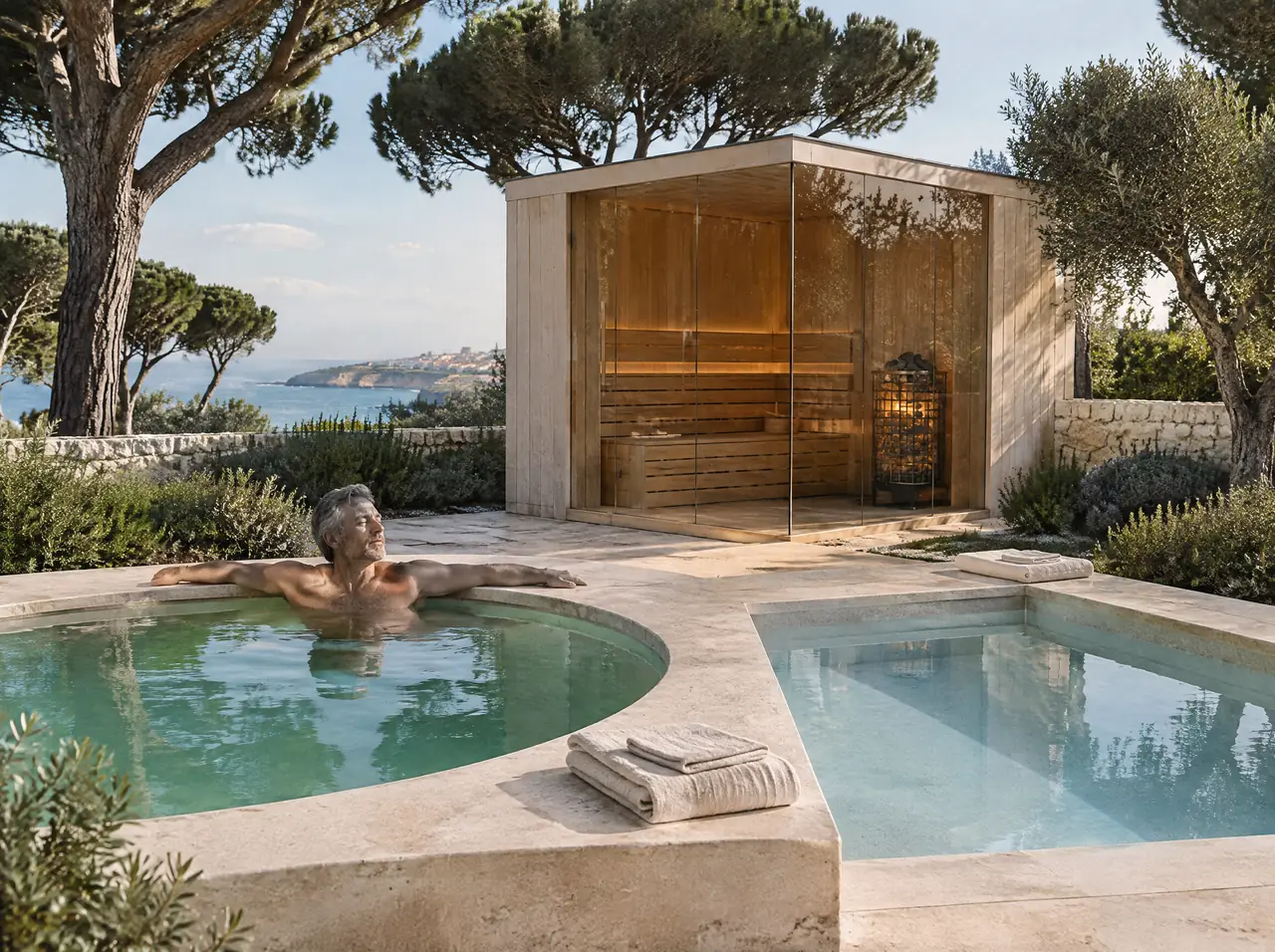
Warm pool, cold pool, one plant room
A 38 °C pool and a 4 °C pool side by side, with a sauna or without. One plant room, one drawing.
Read on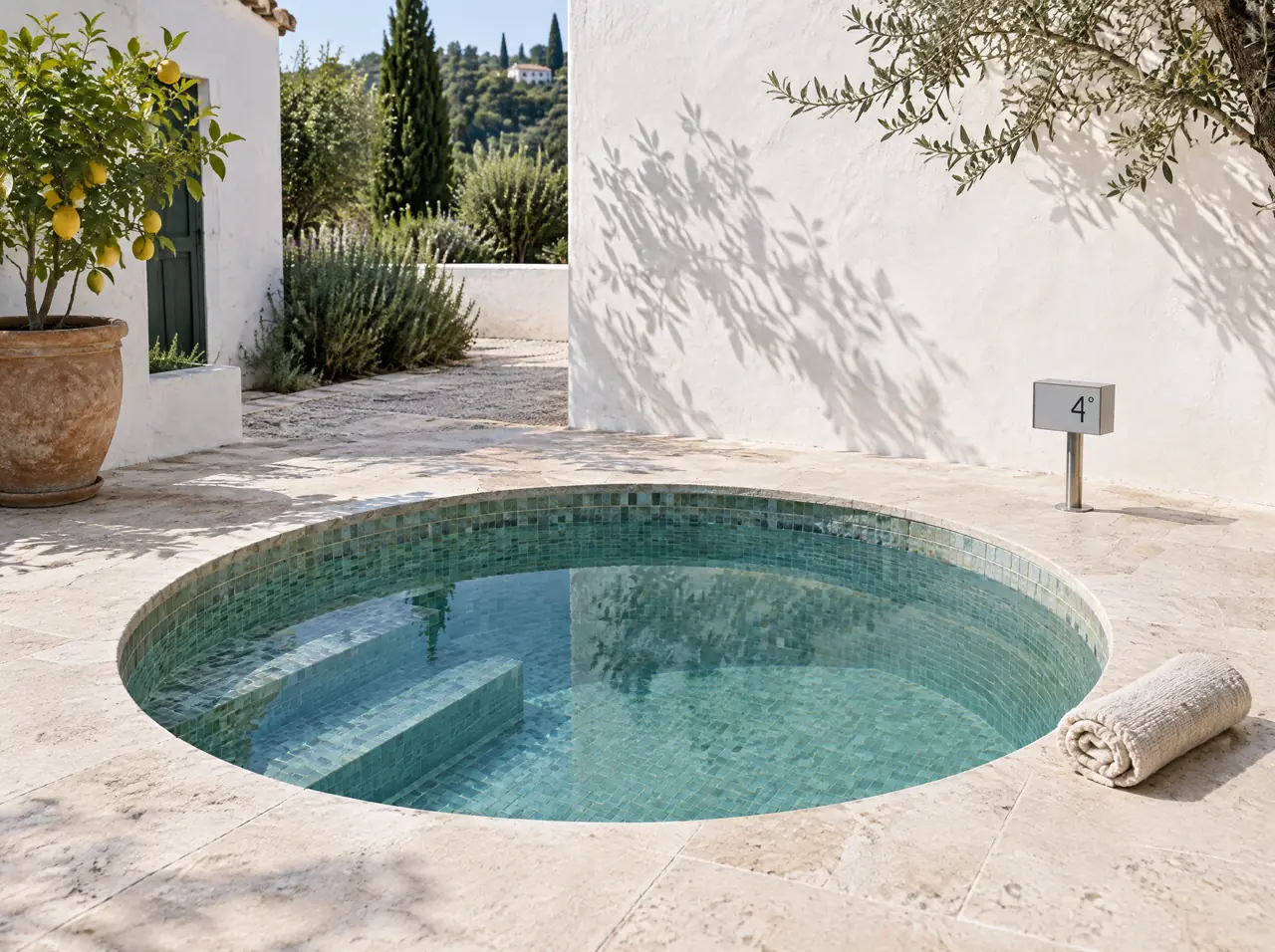
Cold plunge pools built into the terrace
Round or square, glass mosaic or tile, flush with the floor and held at 3–5 °C. The machinery stays out of sight.
Read on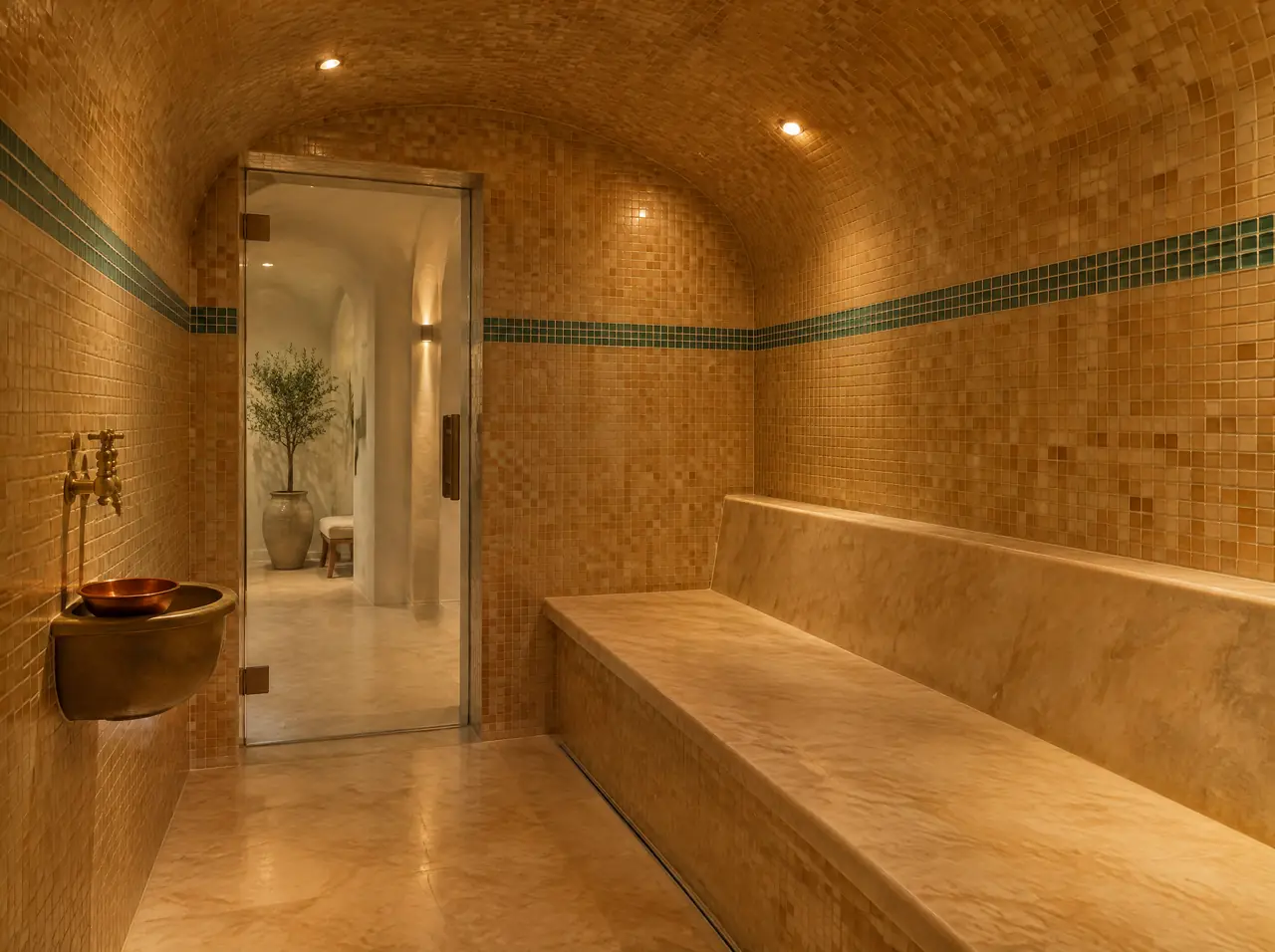
Hammams in mosaic, with the generator next door
A tiled steam cabin for two to eight at 43–48 °C: sloped ceiling, warm bench, floor drain, extraction, glass door.
Read on