Collection · 11 · Heated timber tubs
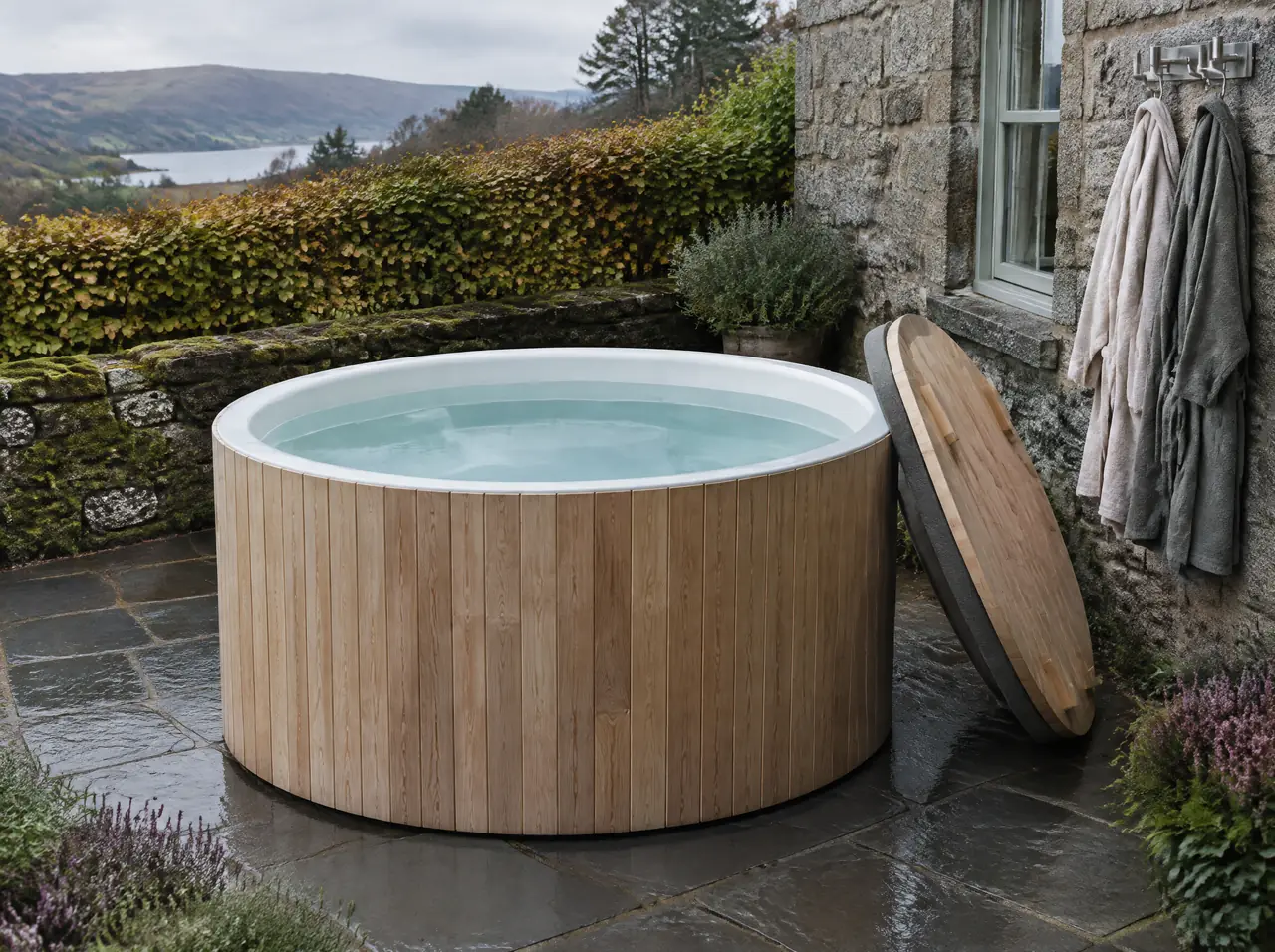
A wooden hot tub for the terrace: ash staves, white liner, 38 °C
The warm twin of our plunge tub: thermally modified ash or pale cedar staves around a smooth white fibreglass liner, no metal hoops, room for two to six adults, 1,000 to 1,800 litres held at 37–39 °C by an electric heater, with a cover and a filter. For private homes only, on a terrace that can take the weight.
Sections on this page
One joinery, two temperatures
Readers of the timber plunge tub page will know the object: staves of thermally modified ash or pale cedar, shaped into a round or an oval, with a white fibreglass liner inside that shows as a clean rim above the water. The heated tub is the same joinery with the opposite machine. Instead of a chiller holding 4 °C, an electric heater holds 38 °C; instead of a tub for one, it seats two to six on a moulded ledge. Side by side on a terrace the two are the simplest hot-and-cold pair we draw, and the one that needs no building work.
Three sizes, and what each one weighs when full
| Tub | Litres | Seats | Full weight, about | First heat on a 6 kW heater |
|---|---|---|---|---|
| Round, close | 1,000 | 2 | 1.3 t | about 4.5 h from 15 °C |
| Round or oval | 1,400 | 4 | 1.8 t | about 6 h |
| Large round | 1,800 | 6 | 2.3 t | about 8 h |
The weights are why we ask where it stands before we ask which timber. A ground-level terrace on a slab is fine. A timber deck needs its joists checked and usually a pad under the tub. A roof terrace or a first-floor balcony goes to an engineer with the figure above, and in a block of flats to the owners' association. Once it is full nobody moves it, so the drain and the power point are planned for that spot.
Timber tub, acrylic spa or built-in basin
| Heated timber tub | Drop-in acrylic spa | Built-in hot tub | |
|---|---|---|---|
| Look | staves and a white rim; furniture | a moulded shell in a surround | mosaic, part of the terrace |
| Jets | none; still water | yes | yes |
| Building work | a level base and a socket | a deck cut to the shell | a shell, tanking, a plant room |
| Running the heat | electric heater; the cover does the saving | electric heater; insulated shell | heater in the plant room |
| Moves house | yes, empty | with effort | no |
| Businesses | no, homes only | yes | yes |
| Indicative | €4,000–11,000 | see the hot tub page | €7,600–24,500 |
If you want to be massaged, this is not the product; the hydromassage hot tub is. If you want warm still water, timber under your hand and a tub that can go with you when you sell the house, it is.
Why the heater is electric, and when a stove is not
The heater is an electric unit of about 3 to 6 kW with its own circulation pump and a controller, on a dedicated protected circuit from the board, like a chiller. It heats slowly and holds exactly, it makes no smoke and it needs no chimney, which on a terrace between neighbours is the end of most arguments. A wood-fired stove is the romantic alternative, and we are asked about it in Ireland and in the Spanish interior. Whether it is allowed depends on where you are: smoke-control rules, fire clearances and what the owners' association permits differ by municipality. If you want wood, ask us and ask your town hall in the same week; where the answer is yes we draw the stove outside the tub with a flue to a safe height.
Cover, filter and water that stays clear
Warm water needs more care than cold. The insulated cover goes on whenever nobody is in, which keeps the heat and keeps the leaves out; the filter and pump run on a timer; and the water is kept clean with a mild disinfectant you measure with a test strip, a partial change every few weeks and a full change a few times a year depending on how many people use it. A tub of 1,400 litres is small enough that this takes ten minutes a week and large enough that neglecting it shows. The handover sheet puts the routine in plain words, and the liner, being white, tells you when you have slipped.
Terraces, decks and the Atlantic question
In the south the heated tub is an October-to-May object; in July it is covered and the cold tub beside it does the work, and a tub in all-day sun wants a pergola as much for the timber as for the water. On the Atlantic it is a year-round one, and the design turns to the weather: a cover with straps for the wind, 316 stainless on every fixing because salt air finds the rest, a drained base so the staves never sit in water, and a position in the lee of a wall. Thermally modified ash shrugs off the damp; cedar silvers faster and is oiled or left alone according to taste.
Tubs stay with households
Like the cold tub, the heated timber tub is sold to private households only. A tub is shared by people who know each other; a hotel or club needs a basin that can be drained, cleaned and documented between strangers, and for that we draw the built-in hot tub with its plant room.
The cold twin and its chiller are priced in the price list; the heated tub's range is in the table above. Pick the cold tub in the kit builder and tell us in the message that a warm one stands beside it.
How long does it take to heat?
From a cold fill, four to eight hours depending on the size, on a 6 kW heater. After that the cover does most of the work and the heater only tops up.
Can the heater and a chiller share one tub?
A liner can be plumbed to both, but nobody wants to wait a day for the change. We draw two tubs: one warm, one cold.
Will the staves leak?
No. The water is carried by the fibreglass liner; the timber is the outside and never touches it. That is also why there are no hoops.
Is it a hot tub with jets?
No. It is still, warm water. Jets, a blower and a plant room belong to the built-in hot tub.
Alongside
Warm water, and the cold that goes with it
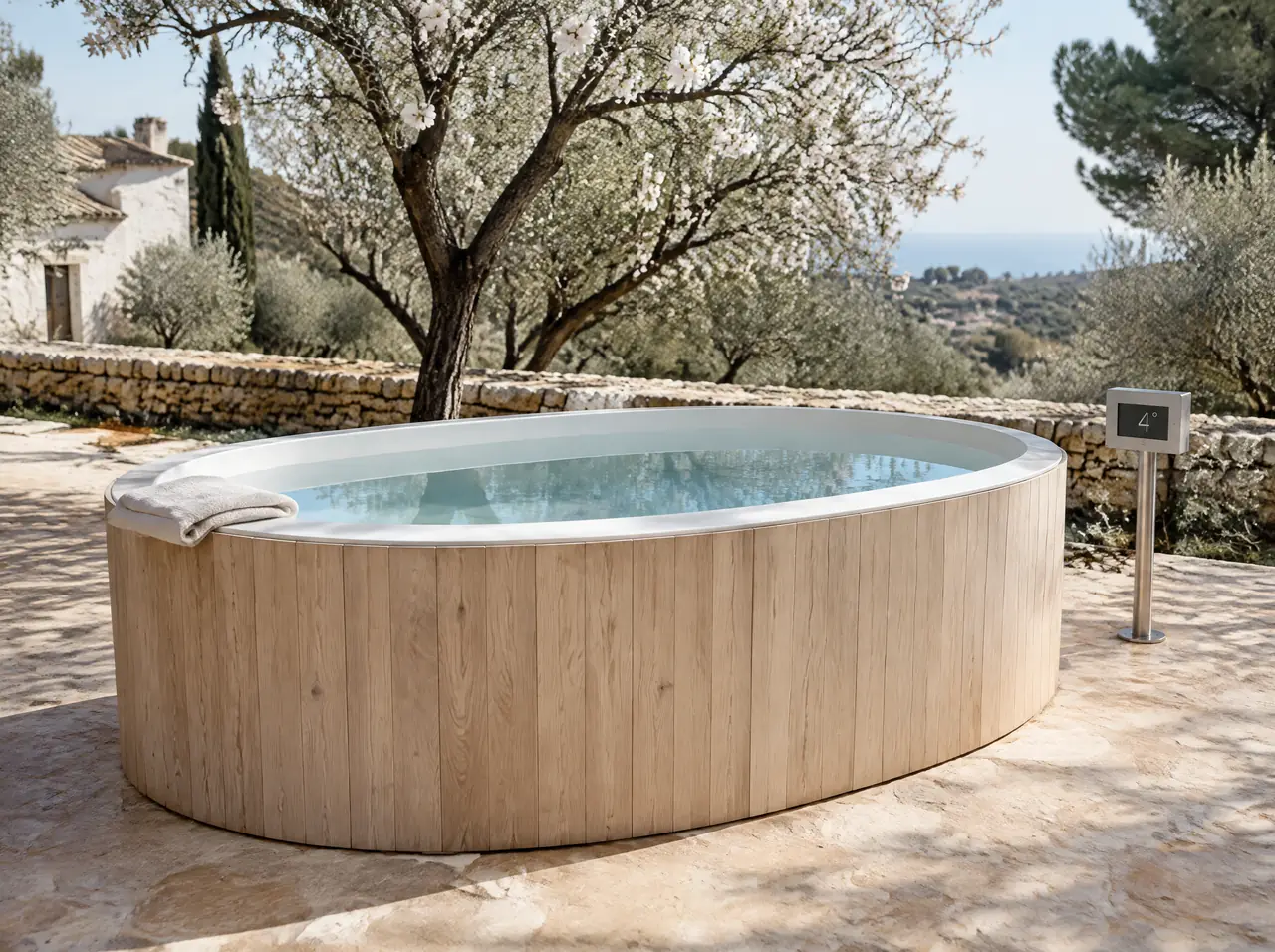
Wooden plunge tubs with a white liner
Oval or round tubs in ash or cedar with a white liner, 250 to 1,000 litres, for private homes.
Read on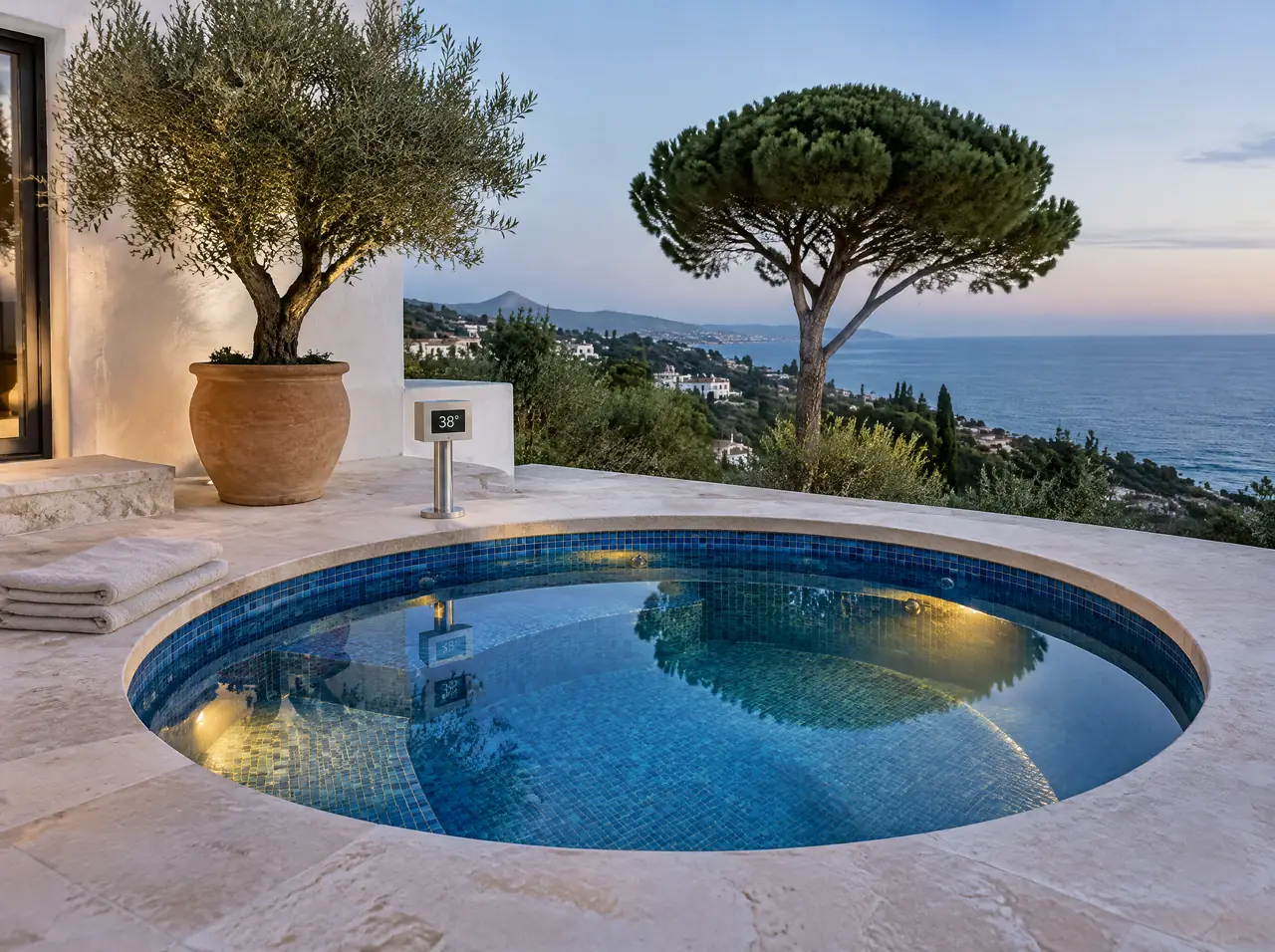
Hot tubs laid in mosaic, jets on the seat wall
A warm basin at 36–38 °C set into the terrace, in mosaic or tile or as a drop-in shell, with the pump and heater in a plant room.
Read on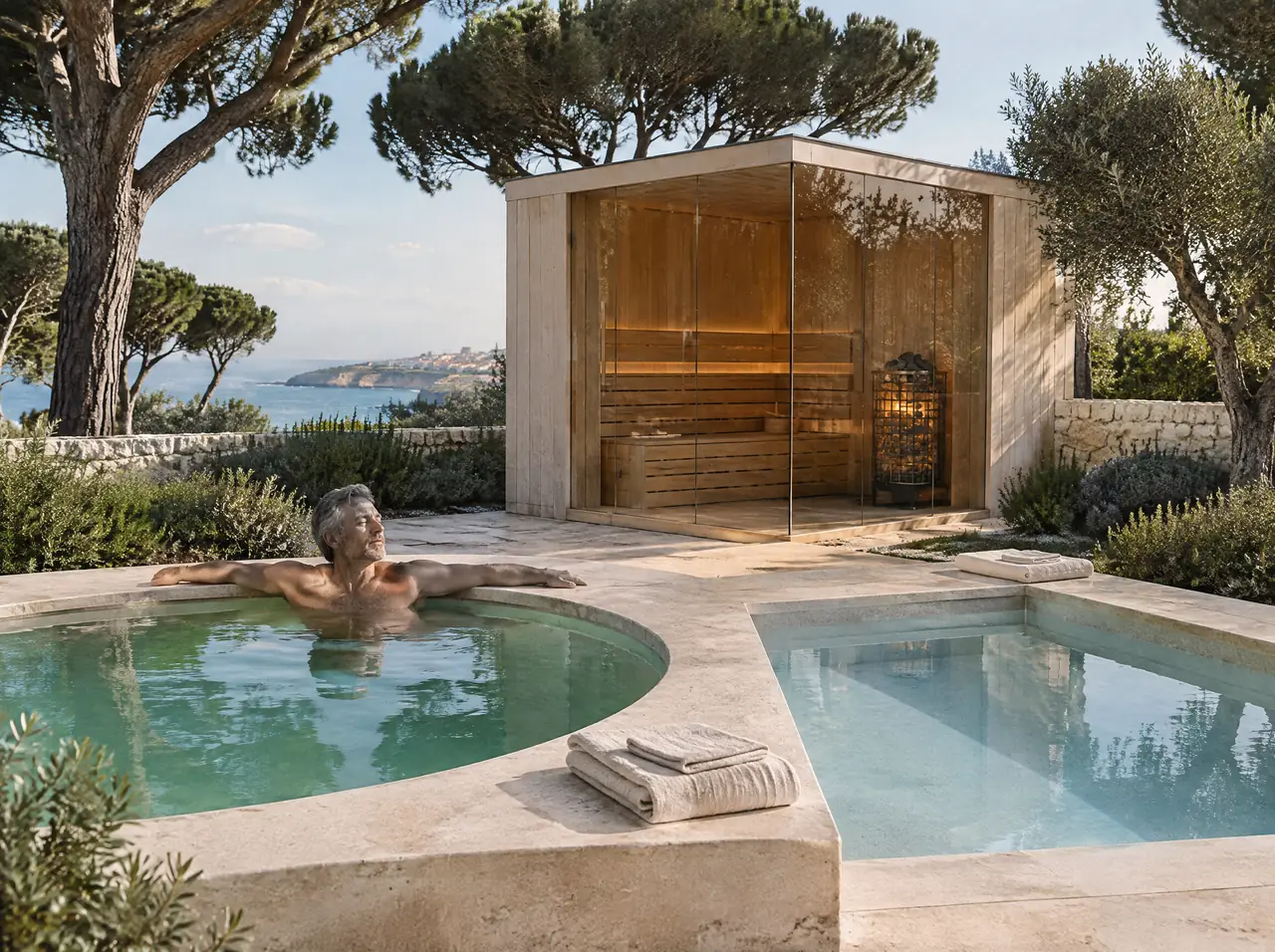
Warm pool, cold pool, one plant room
A 38 °C pool and a 4 °C pool side by side, with a sauna or without. One plant room, one drawing.
Read on